Tuesday, May 31, 2011

May Holidays--Hirdirlez and Victory Day in Sevastopol

The ruins of Chersonesus.


The Victory Day Parade in Sevastopol.


A Russian submarine up close on our tour of the harbor.

Here I am sitting in front of the monument to sailors lost at sea.

Our Sevastopol friends who shared their holiday with us.


The month of May in Ukraine is a time of many holidays. The first of May holidays—International Workers Day—is followed by the May 9th holiday—Victory Day—which celebrates the end of World War II (called the Great Patriotic War) and honors those who died and the surviving veterans. And the numbers that died here are staggering—40 million in all of Russia which includes the 6 million who died in Ukraine, 2 million of which were Jews murdered in the Holocaust. Once I learned more of the history of the war here, I understood the tremendous importance the May 9th holiday holds for people in Ukraine.
May is also a month of commemoration for the Crimean Tatars. May 18th is the anniversary of the Deportation of the Crimean Tatars and is marked by a huge gathering in the center of Simferopol. This year another gathering of Crimean Tatars also occurred in May—a celebration of the spring holiday Hidirlez. In the past this holiday has only been marked by small neighborhood gatherings, but this year a huge outdoor festival was organized which attracted Crimean Tatars from all over the peninsula. Nadjie had told me about it weeks earlier and we had made plans to go, but obviously, that was not to be. I ended up going with the Seytaptievs, and my PCV friend Cheryl was in town so she also came with us. We got an early start, driving about 15 miles to a beautiful tract of rolling green land. Booths were already being set up and people were gathering, and soon crowds of people—almost all Crimean Tatars—thronged the area. There was a main stage with traditional dancing and singing, booths selling crafts, organizations like the library promoting their services, many kazans (large wok type pots) filled with plov cooking over open fires, traditional games, men proudly displaying their homing pigeons (a very developed hobby here), and much more. The crowd was estimated at over 10,000, and it was a great beginning to what is destined to become an annual event. And it felt joyous, hopeful—people laughing and having a good time—an antidote to the grief of remembrance that occurs for so many Crimean Tatars around this time, as the tragic stories of deportation come flooding into people’s consciousness. Neshet dragged Serdar out of bed and told him he had to come. He was a bit disgruntled by it all at the beginning, but I think by the end, he was perhaps glad he had the opportunity to experience this with his father. (Go to my library blog http://crimeantatarlibrary.blogspot.com to see photos of Hidirlez)
The day following Hidirlez, Cheryl and I took off for two days to Sevastopol. I have been in Crimea for almost two years, and I had yet to explore the most famous city of Crimea, the Russian dominated seaside port of Sevastopol. I had driven through it several times on the way to other destinations but had never lingered. Cheryl and I had received an invitation to visit from a woman we met when we did the professional women’s seminar in March, so we decided the May 9th holiday weekend would be a good time to take her up on her offer. And she was delighted to show us around. Turns out she has a twin sister—they each have a young child and live with their mother in a comfortable new apartment, where we stayed for the night. We spent the first day walking around the ancient ruins of Chersonesus with a knowledgeable English speaking friend of theirs as a guide. Chersonesus is the site of an ancient Greek colony founded approximately 2500 years ago on the coast of the Black Sea. The ruins were excavated beginning in the 19th century, and today it is a world heritage site and one of the most interesting archaeological sites in Crimea. It is a beautiful location and despite the cold wind we spent several hours exploring the ruins. Afterwards, we went to the panorama museum in the city center, another famous Sevastopol tourist site. It is an immense circular building that contains an amazing painting of the Crimean War and the siege of Sevastopol. The installation is a mix of the actual painting on the curving walls and life size replicas of battle scenes. It is very hard to tell where the replicas end and the painting begins. The building was opened in 1905, but like all of Sevastopol the Panorama Museum was destroyed in the Second World War--not a single building survived intact. It reopened in 1970.
The following day was the Victory Day celebration, which began with a parade of veterans of the war—ancient men with chests full of medals—and then soldiers from the present military forces. Sevastopol was an especially significant place to view the Victory Day parade—besides being the site of some of the most ferocious fighting of the war, it is also the present day location of the Russian naval fleet, so the Russian forces were very much in evidence and the Ukrainian and Russian sailors marched together. Crowds thronged the sidewalks to watch the parade and constantly shouted hooray and thank you as the veterans walked by, giving us some sense of how deeply imbedded the experience of the war is in people’s consciousness. There is not a single family in Ukraine that isn’t affected by the war, that had at least one family member die or suffer tragic consequences.
We spent the rest of the day wandering around Sevastopol, looking at all the Russian naval ships docked in the port, taking a short cruise of the harbor where we could see them close up, watching the crowds of people enjoy themselves on this holiday. The weather didn’t cooperate much—it was very cold for this time of the year—but it didn’t keep people from taking advantage of the holiday to party with friends and family. Later there were big fireworks, but by that time we were on a bus back to Simferopol. I was glad to have a chance to see some of Sevastopol, especially with people who lived there as guides. But I was also glad to get back to Ak Mechet. Sevastopol is so Russian—for years it was a closed city and no one but Russian citizens were allowed to live there. As a result, the Crimean Tatar presence seems to be pretty minimal. I did see a mosque, but when I questioned our hosts about the Deportation Memorial Day on May 18th, they did not know what I was talking about. And never in my two years of working at the library has there been any reference to the libraries in Sevastopol, and no one seems to have relatives there. I do know people who have lived there and they all love it—it is a beautiful city—but they are Russian. Russian rule of Crimea devastated the Crimean Tatar population and culminated in the genocide of the deportation, so it is no wonder that most Crimean Tatars have little connection to Sevastopol.
I came back with just a couple of days to get a lot of work done at the library on the upcoming seminar, and then I was off again to Chernigov, my training site when I first came to Ukraine. More on that in the next blog.
Love to all from Crimea.

Monday, May 30, 2011

A tragedy befalls my friend Nadjie


It has been four weeks since I last posted in this blog. I feel like so much has happened in those four weeks, and that in many ways, my life here has been much altered.
The two days following our day trip to Tahankut were vacation days from the library. I don’t remember exactly what I did, but I enjoyed some time at my house, getting caught up on household chores, taking walks up into the forest and hills. I came back to work at the library, prepared to help Nadjie with preparations for our upcoming two-day SPA (Peace Corps grant program) sponsored project. However, Thursday morning as I was teaching my English class at the library, tragedy struck. I hadn’t even seen Nadjie that morning—she was out running errands for the seminar—but then we got a call that she had fallen and was at the emergency hospital. Over the course of the day, we learned that she had broken her hip. I was afraid that with my limited English I would be in the way if I immediately went over to the hospital, so I called her and promised to come the next day. I found out later that it was me she wanted to come to the hospital that day, so I regretted that decision.
A word about health care in Ukraine. Though the government says that there is free health care as there was during Soviet Union time, in reality there is little that is free. I don’t thoroughly understand it, but you have to pay for all kinds of things—bandages, medicines, operations, treatments. These aren’t “official” charges, but if you want to have an operation, for example, you are going to need to give the surgeon some money. Some people tell me that if you are truly desperate, they will do the operation for free, but otherwise payment is expected. And given the fact that doctors make so little money here—only $150 to $200 a month—it isn’t surprising. So when Nadjie was told that she would need an operation, I knew she had no money and immediately sent out an appeal to my friends back in America and the Peace Corps Volunteers here who know her.
As I expected, my friends were amazingly generous, and I collected over $2000 to help pay for Nadjie’s medical bills, a large sum in Ukraine. However, she decided not to have an operation because the doctor (who only would talk with her once he learned that she would be able to pay for an operation) told her that an operation had only a 50% chance of having a good outcome. The other alternative was to have a toe to waist cast put on her broken hip and go home and lay in bed for three months. Which, unfortunately she chose, despite my assurances that I could raise whatever money was needed. In the end, it wasn’t so much the money, but the 50% prognosis and her desire to get the hell out of that hospital. Which I certainly understood once I saw the cramped condition of her room (four patients in a very small space) and the lack of nursing care.
So now she is back in her little home, which fortunate for me, is only two blocks from the library. I go to see her often and have gotten to know her 38-year-old daughter and two-year-old grandson who have moved in with her. I hate to see her lying on her bed, unable to move, but I also treasure the time it has given us to just sit and talk, which we seem to be able to do, despite my poor Russian. And her spirits remain amazingly (at least to me) good, despite the fact that she must know in her heart she will probably never be able to walk normal again. For a long time, I despaired of her ever returning to the library, but now I think her energy and love of life will carry her through. We are already talking about what we are going to do when she returns to the library in the fall, what projects we will work on together. And because she does live so close, I have continued to be able to involve her in my work here, especially as the library decided not to postpone our planned seminar but to proceed without her direct guidance. I will write about the seminar in a later blog post.
When I visited her in the hospital and she understood that she would not be returning to the library for a long time, if ever, she said to me, “Don’t forget me.” I responded instantly, “Hekogda (never)!” As is so often the case, the loss of someone in your life makes your realize how precious they are to you, and so is the case with Nadjie and me. Over the past two years, I have come to love her and recognize her as a true friend in my life here. I have resolved to help her in any way I can and to truly “not forget her.”

Tuesday, May 3, 2011

Tarhankut with the Seytaptiev's


It’s a Tuesday afternoon, and instead of sitting at the library where I usually am on a Tuesday, I am at home, sitting at my desk, looking out on spring with the apricot and apple trees in bloom. It’s May 3rd and the second day of our two-day May 1st holiday. There are a lot of holidays here in May—Easter (Paska), then May Day, then the Great Patriotic War memorial holiday—all involving at least one day off from work. I also have been home more than usual because for a week, the library had no electricity. I’m unclear why, except that it had something to do with the fact that the Ministry of Culture has never appointed a replacement director for the library when the original director resigned last year, so we really don’t have a director who can make the Ministry of Culture pay the electric bill. So since no electricity meant no computer, I worked at home. Did get a lot more done, but I sure missed being at the library and around the people there.
This past Sunday I took off with the Seytaptiev’s for a May 1st holiday picnic. They didn’t want to go camping like we did last year because it is still pretty cold at night. Hopefully we will go sometime in June. We were debating where to go—the cave city of Eski Kermen or Tahankut in far western Crimea. Tarhankut won out because Serdar has always wanted to go there, and so have I, once he showed me pictures of it on the internet. Problem is that it is pretty far and almost impossible to get to by bus. It looked to be about a 3-hour drive, and we didn’t get going very early. Actually, it is really about a 2 ½ hour drive, but because we didn’t follow the maps, it took us longer. The typical way of navigating around here seems to be to just stop people on the street and ask for directions. That is what we frequently did when I was driving around with the library for our regional seminars last year, and it is what Neshet did this time too. However, one of those directions ended up sending us down a very bad, ultimately dead end, road. Backtracking took a bit, and finally, exasperated, Serdar got the GPS going on his phone, and we followed that. Which doesn’t take into account things like major potholes and cows wandering across the road, but did give us the shorter route and ultimately took us to our destination. Coming back was much easier and faster.
Tarhankut lived up to all its expectations. Initially there is the village with a lighthouse and not such huge cliffs, but then we followed a dirt road along the edge of the cliffs and it just got more and more spectacular. A lot like the headlands of northern California. It would be a wonderful place to kayak, because the surf in the Black Sea is not so strong and there are many caves along the shoreline to explore. We were on a large open grassy area on top of the cliffs. Eventually we pulled over and hiked around, took pictures, and got out the “shashliking” equipment. Shashliking is the Russian form of barbecuing, which is cooking chunks of meat on skewers over a fire. A very popular activity around here. Any holiday the nearby forests are filled with people shashliking.
Serdar decided he wanted to practice driving, so I went with him in search of a bush to pee behind. It was a little nerve wracking—the road is right on the edge of the cliff—but he really has driven enough now that he is pretty competent. Just that a mistake would end up us not in the ditch but instead… Actually, when we left Neshet had him drive the whole length of the road along the cliff, which really made me nervous, but all was well (or I guess I wouldn’t be writing this, would I?)
The weather wasn’t great—kind of cold and cloudy—so we didn’t say very long, but all of us were so glad to have seen this far edge of Crimea. As Neshet said, Crimea has so much varied topography—the sea, the steppes, mountains, marshes, forests, sea cliffs, rolling hills—all in a fairly small area. I think you can drive west to east in Crimea in maybe 8 hours or less.
Off soon to have dinner with the two young PCV’s who live here in Simferopol. They hang out quite a bit together, but I really don’t see a whole of them, which isn’t surprising. I am, after all, quite a bit older than their parents!
With love from Crimea.

Friday, April 29, 2011

On Chatyr Dag with Serdar


It is so very hard to keep track of my life here, it feels like sometimes. What has happened since my last blog post? I am always asking myself. In some ways, every day brings new thoughts, adventures of one kind or another, new ways of thinking about something that I need to shift around in my head. And, always, much of it is about language. Feeling good, feeling bad, I’m getting a little better, I’m getting worse and I will never learn it, no one wants to talk with me, etc, etc. Without a doubt, one of the biggest challenges of my life. Soon I will be going back up to the city of Chernigov in northern Ukraine where I spent my first two and a half months here in training. This time I will be coming as an “experienced” volunteer, ready to impart words of wisdom…or not. But I know—I remember—that many of the questions will have to do with learning the language. And I think some about what to tell people, especially those older volunteers who like me are already struggling trying to learn Russian. Here I am, two years later, still struggling, and why do I keep trying, I ask myself? For me, the answer is clear—I want to be able to talk with the people I love—Nadjie, Lenura, Neshet, Safie. Sometimes it seems we will never be able to progress in our relationships unless I can somehow learn Russian better. But then I have to keep remembering that we did get to this place—of caring deeply about each other—with even less language than I have now. Somehow it happened in spite of our inability to freely speak with one another. And that is the fact I need to keep clear in my head, and which I need to convey to the new trainees.
Last Saturday Serdar and I decided to go up into the mountains—to Chatyr Dag, the peak I can see from my walks in Ak Mechet—to, as Serdar put it, clear our heads from all the stress of the visa disaster and also, for him, girlfriend anxieties. We knew there would still be snow up there and that was part of the appeal, despite the assurance that it was going to be a very cold day. And that it was, but we were dressed for it with warm layers, hats, scarves, gloves (though Serdar hadn’t brought gloves, so I brought two pairs and he ended up wearing the gloves that use to be my mother’s—it was a nice feeling to see him keeping his hands warm with something that kept my mom’s hands warm too. She would have liked that.)
It took us a bit to get there—usually only a 45 minute bus ride from the bus station in Simferopol—but for some reason the bus driver told us he wouldn’t drop us off at Pereval (the pass), and instead we had to take the trolley bus. The trolley bus is the world’s longest trolley bus—50 miles from Simferopol to Yalta. And though it is very cheap, it is also very slow, as all the babushkas flag it down at every little settlement. But finally we did make it, 2 hours after we started, which didn’t give us enough time to make it to the highest peak, but definitely enough time to get up to the plateau and the beautiful views of Mt. Demerdji and the Black Sea.
The minute we were away from the road noise and walking up through the forests, a happiness came over me that never left that whole day. Indeed, I thought to myself later that it was one of the happiest days of my life. Being with someone I love so much in a place I love so much—it is a gift that I don’t know what I have done to deserve. My relationship with Serdar has made me think about love and what it means and how it comes in so many different unexpected forms, and how we just have to stay open to whatever life brings us. As we sat up on the mountain top, eating some lunch out of the wind, watching the fog roll in and roll out, laughing and talking about all kinds of things, I felt a deep gratitude for the gift of my life here in Crimea.
It’s a week later now, kind of a hectic, hassling week, especially with the electricity being turned off at the library for reason unbeknownst to me. But today it got turned back on and I had a good chat with Nadjie and we made a plan to work together tomorrow for a bit. And then on Sunday and Monday hopefully I am going to take off somewhere with the Seytaptiev’s. It’s the May 1st holiday, and last year we went on our maiden camping voyage. I am sort of hoping for that this year, though I think they think it is too cold. But whatever we do, it will just be a treat to be with them.
So bye for now, dear readers. And to at least some of you—I will see you this summer. With love from Crimea.

Monday, April 25, 2011

Trips to Kyiv, PCV's come to Crimea

Doug Teschner, the director of the Peace Corps in Ukraine, visited our library.
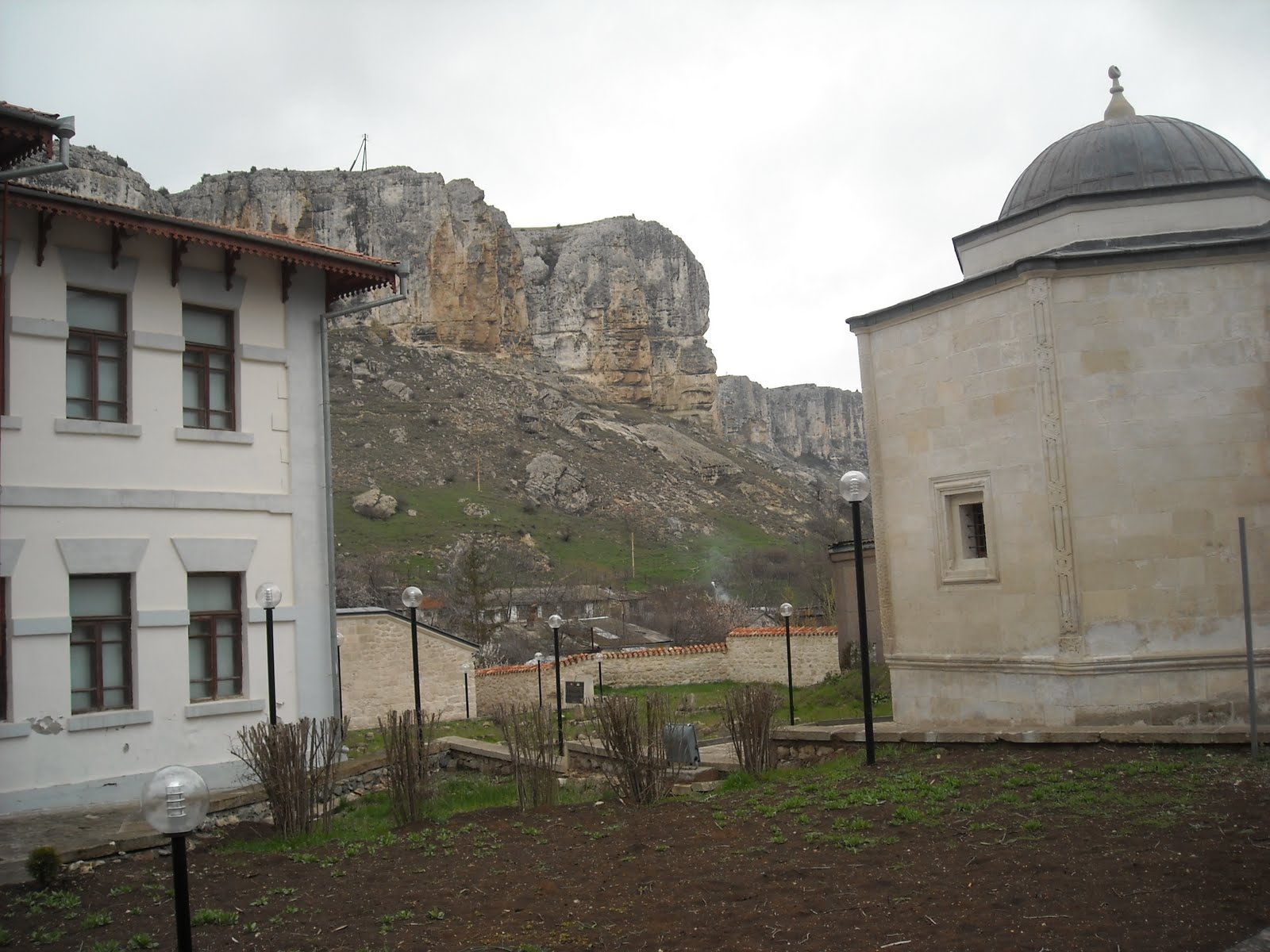
These are photos of the 500 year old Islamic school in Bakcheseray.


In between trying, on the one hand, to get Serdar a visa to America, and on the other hand, trying to get over the disappointment of not spending that kind of time with him, a lot of other things have been happening here in my Crimean life. Two days after I got back from Kyiv with Serdar, I left again on an overnight train to Kyiv, this time with Nadjie, my counterpart at the library, to take part in a Peace Corps presentation at a library fair. This was a first time ever event, put on by Bibliomist, which is a Ukrainian organization funded by the library initiative of the Bill and Melinda Gates Foundation. The fair organizers invited the Peace Corps to give a workshop on Peace Corps Volunteers working with libraries in Ukraine, and Murat, the head of that PC program, invited me and 3 other volunteers and our counterparts to give a presentation. I really didn’t want to go all the way to Kyiv for basically what would be a 10 minute power point, but I knew Nadjie would be excited for the chance to go to Kyiv—where she has only been because of Peace Corps related events—and that it would be a great opportunity for her to network with other librarians.
So off we went on the overnight train, this time 2nd class at least since Bibliomist was paying Nadjie’s way. We arrived early on the morning of the fair, squashed ourselves into the rush hour subway (a first experience for Nadjie), merged out into the centre of Kyiv and walked to the beautiful modern building were the event was to be held. It was quite a big deal. There were over 400 attendees and the opening ceremony included remarks by someone high up in the government (was supposed to be the prime minister but a lower down was substituted), the American Ambassador, and other dignitary types. It reminded me a bit of the book fairs I attended back in my bookstore days with lots of booths showcasing their organization’s programs and selling their wares. Our presentation was later in the afternoon, and all went well, though the attendance was sparser than expected because of a competing larger event.
After the fair was over, Nadjie and I and my PCV friend Cheryl and her counterpart who were also there, walked to a nearby restaurant. It was the one place I knew in Kyiv that served some vegetarian options (for Cheryl’s benefit), but they seemed to have changed ownership since the last time I was there and the veggie burger went by the wayside, along with any decent food. But it was still fun to be at a restaurant, also an experience that Nadjie I think rarely has.
We got back the next morning around 11:30. I went home and tried to recover from all the train travel of the last few days because in three days, a large group of older PCV’s was going to descend on Simferopol for their meeting in Crimea, for which I had done most of the planning. It really was three of us organizing it, but since the other two don’t live in Simferopol where the meeting was to be held, I took care of most of the logistics. I got an email later than day informing me there would be the added twist of hosting the Country Director (head of the Peace Corps in Ukraine) that Friday morning also.
So I knew there would be a lot of work and a lot that could go wrong, given that the group now numbered about 30, but it turned out to be a very successful event and weekend. The weather certainly didn’t cooperate. Volunteers in the rest of Ukraine think it is summer all the time down here despite what we Crimean Volunteers say, but this time they saw for themselves the reality of spring Crimean weather. On Friday cold rain greeted them, and Saturday wasn’t much better, though the rain mostly held off until it was substituted by hail up on Chufat Kale. And at least some places—like my library and the Khan Palace we visited on Saturday—had no heat. But the hotel was warm and I think everyone was just happy being in the beauty of Crimea and for many of them, revisiting with friends from training.
I have been to the Khan Palace and Chufat Kale many times, but this time I and a couple of friends took a little detour to visit the 500-year-old medresse (Islamic school) that is being restored with the help of the Turkish government. I really didn’t know anything about it until Nadjie told me that it should definitely be on our tour of Bakcheseray. There wasn’t time for the whole group to go there, and most chose to go to the 8th century Byzantine monastery on the way up to Chufat Kale. But having been to the monastery many times, this time I wanted to see the medresse. There were no other people there, and despite the “fresh” look of some of the buildings, I still felt the ancientness of the place as I gazed up into the cliffs of Bakcheseray, trying for a few moments to imagine what it must have been like living in Crimea 400 years ago when the peninsula was filled with Crimean Tatars and their schools and mosques.
It is a week or so later now and I want to finish this post, go for a walk, and then venture down to visit Zera, the owner of the corner store who keeps asking when I am going to come for a visit. So more later about my ongoing adventures.
With love from Crimea.

Monday, April 18, 2011

Visa to America....or not

It’s been a couple of weeks since I’ve written a blog post, and so much has happened in those two weeks. Just read my last blog post, which I usually do before writing a new one, and I see my last sentence was something about “Serdar will have his visa and we will be planning our trip to America.” Unfortunately, that is so not the case, and I feel like I have been dealing with that fact nonstop since I last wrote a blog. But here is the story:
Serdar and I got on the overnight train and headed up to Kyiv for his visa interview at 10:30am the next morning. We arrived at the consulate early and joined the crowds lined up outside the building, waiting for their visa interviews. There was a huge group of young people going to America on the “Work and Travel” program, which basically is pay your way to America, work shitty resort jobs—house cleaning, etc—and live with other Ukrainians. There was another separate line for students going to America to study, and our line, a mixture of all kinds of people, many wanting to visit relatives in the States. Though an applicant has to go to the interview alone and therefore I couldn’t be with Serdar during his interview, I hung out with him in line, and after he went in the building, with the other husbands, friends, etc. We waited about an hour, and then, one by one, they all started coming out, all shaking their head no, some of the women crying. No one in our line, including Serdar, got a visa. I found out later that only 3% of the people who apply from Ukraine get tourist visas. I guess there is such a big fear on the part of the U.S. government that the person will stay illegally in the U.S.
I had just assumed that Serdar could give them my letter explaining he would be travelling with me, a Peace Corps Volunteer, and that he would be given a visa. And I was so wrong. He never even got a chance to give them the letter, they clearly had rejected his application even before he showed up, on the usual grounds of “not enough ties in Ukraine,” despite his entire family living here and being in first year of medical university. Some of the other people in line seemed to have even stronger ties—spouses and young children living in Ukraine—but still they were denied. I wish I had understood more about the visa process before we attempted this—somehow I would have gotten it in the application that he would be travelling with a Peace Corps Volunteer, because I still believe it would have made the difference.
I have since been trying various ways to appeal the rejection, including writing my congressman, who did agree to send a letter of support, and talking with the director of the Peace Corps in Ukraine. So far, nothing has changed, and I am about to give up and readjust my sights to traveling by myself to America this summer. Serdar, I think, has already let go of it as time has gone by. We were both tremendously disappointed, as was his parents and grandparents. I felt I let all of them down so much, because I was so confident that Serdar would be getting a visa because he was traveling with me, though they, of course, understood that I had no control over the process and also saw that I was as sad as they were.
I now wonder whether Serdar will ever be able to go to America, unless he goes under some kind of study program. It was such an eye opening experience for me to the privilege of being an American in this world where we just assume we can travel almost anywhere without the problem of being denied a visa.

Tuesday, April 5, 2011

The house that Neshet built and a trip to the village

Photos of Sasha's house that Neshet designed and built


At Lenura's mother's 60th Birthday
Lenura's grandmother is on my right
Lilye's brother-in-law makes a toast. Her husband, Abulmeet, on her left.
Tuesday at the library. It is a crazy week, couple of weeks actually. Tomorrow I am going to the Children’s Library to conduct my morning English Club and also help a student with a special presentation she is doing. Then later in the afternoon I am meeting Serdar at the train station, and we are off to Kyv on the overnight train for his visa interview at the U.S. Embassy the next morning. We will spend the rest of the day wandering around Kyiv, and then take the overnight train back to Simferopol so he can get to his classes that morning. I will go my tutor’s and the library for a bit and then home to get ready for my next trip to Kyiv, a day and half later. Nadjie and I are going to do a presentation at a big library fair. A great opportunity for her and the library, but it involves yet another overnight train, day in Kyiv, and overnight train back. At least for most of these trips, we will be going second class, which is a bit more comfortable. Except for the bathrooms, but I won’t go into that…
Last week Neshet invited me to come see the house he has been building the last three years for his “client,” Sasha, who I think is basically who he works for now. Sasha is a wealthy businessman and has several stores which Neshet has helped design and build. I had heard much about the house over the last two years, so I was glad to get a chance to see it. I know that Neshet had designed the entire house, including much of the furniture, based on what Sasha wanted which was sort of a French provincial theme, I think. The house is very large—four floors—with large spacious open areas, which reflect Neshet’s minamilist tastes to some degree.
Neshet and Lenura picked me up at the library after an English club meeting. Then we went and picked up Serdar at the university and headed out to Sasha’s house. Spent a nice evening there, touring the house—I especially liked the tile work in the bathrooms—meeting Sasha’s wife and two children, and having some gourmet food—fresh strawberries and blueberries, salmon, shrimp, etc. and wine. They had recently been to America, so it was kind of fun to see their pictures and talk to them about it, all in Russian, of course. But I thought I did pretty well. If people talk directly to me and slow enough for me to understand, I sometimes feel like I am actually having a real conversation. I have found it depends some on the Russian speaker. There are people I just can’t seem to understand at all, like my neighbor Server, who I have been around a lot. But his wife, Maia, and I can carry on a conversation quite well.
But what was really nice about the whole visit was to see how much Sasha respected and liked Neshet and valued his opinion. And to see the pride Neshet took in his work, and rightly so. We sometimes talk about him building and designing a small house for me if I decided to stay on in Ak Mechet. Though I have a feeling such a project could be fraught with many pitfalls, I would love to try and do something like that with him.
On Friday, we all took off in Neshet’s car—which is actually a work van with only two front seats, so riding in it is always a little hair raising—for the village 2 ½ hours north of Simferopol where Lenura’s parents, Lilye and Abulmeet, live. I had been there once before in the summer and have seen them several times at Lenura’s house and like them a great deal. They speak no English but even so, I can always feel the warmth from them towards me. Their lives have not been easy—they live a pretty minimal existence with no indoor plumbing in two small structures in a very isolated village in the steppes, and have also endured personal tragedies, two of their three children having died at young ages. One of them was quite young, I think, but the other was Lenura’s brother who died when he was 18 or 19—accidentally electrocuted. Abulmeet drank heavily for many years after that, but now he is a teetotaler.
The occasion for our visit was Lilye’s 60th birthday. Her mother, who is 87 and I have never met, was also there along with Lilye’s sister and husband, whom I had met before because they live in the same village. We had a wonderful meal—maybe the most dishes I have had at a meal in Ukraine. The variety was endless—pelmini (small meat dumplings) soup, a sort of liver patty, roast chicken, mashed potatoes, meatballs with rice, samsa (meat pastries), omelette rolls with garlic and cheese, a different cheese pastry with garlic, various salads and breads and other vegetables—I am sure I am forgetting something. And for dessert, two fabulous cakes—one “store bought” which is not the same as store bought in America, and a scrumptious cake that Lenura made—which we took turns holding on the ride there as there was a lot of swerving around potholes (especially when Serdar took a turn at practice driving).
There was much toasting and talking and laughter. As usual, there was much I didn’t understand, but I still loved being there and being “part of the family.” We stayed the night but then left fairly early the next morning, much to Lenura’s disappointment. But as always, what Neshet says is what we do, and he needed to go to work for some reason. That aspect of their family life I have a very hard time with. He is totally the decision maker, with little or no input from Lenura, as far as I can tell. I think not untypical here, and particularly in the Muslim families, but hard for this feminist to swallow. I talk to Serdar about it some and am hoping that at least he is getting a little different way of looking at things. Safie doesn’t have the English skills yet for us to talk about such things, but I am hoping in the future. I have decided I am going to try harder to get her to speak English. She is starting to come to my English Club at the Children’s Library, and we are both making more of an effort to speak English together, instead of Russian.
That’s it for now. Next time I write this, hopefully Serdar will have his visa and our plans for a trip to America will have moved on to another level. Love to all from Crimea.