From the Field is a bimonthly newsletter published by the Peace Corps office in Ukraine highlighting volunteer projects across Ukraine. In the last issue, thanks to my PCV friend in Crimea, Cheryl Pratt, our library project was the featured story. I put a link to the pdf under Links of Interest. I think Cheryl did a great job capsulizing the essential details of the project and the need for it. Thanks so much, Cheryl!
A funny (kind of) thing about the photo. I sent Cheryl many photos to choose from and she sent them on to the Peace Corps office and that is the one they picked, with me in the center and Nadjie on my left and another librarian on my right, looking at an old book. Which would have been fine, except that that particular librarian is not the head of that department, and I knew the department head would be upset when she saw the picture. And sure enough, I was right.
There is an undercurrent of competition here in Ukraine that I think comes from Soviet times, when it was a matter of life and death (at least during Stalinist times) to look out only for yourself, to promote only yourself, to be suspicious and paranoid of everyone else outside your very immediate circle. And I think those feelings have gotten passed down through the generations--I know it is something we PCV's come up against constantly--that lack of cooperation, teamwork, and all those other America values so encouraged in the American workplace. Because of the language barrier, much of what goes on at the library is lost on me, but unfortunately that tendency is something I have picked up on more than once.
But maybe not so much with the younger staff. As always, one can hope that as the country moves further away from its Soviet history, some of the more damaging aspects of that time will began to fade. I know it is the hope of the young people to create a more open society than the one in which their parents lived.
Monday, March 14, 2011

Sunday, March 13, 2011
A visit to Kyiv and new friends
My Kazakhstan friends, Aigul and Rustambek.
Sunday morning, back home in Ak Mechet now, arriving on the train yesterday morning after a 15-hour overnight trip, the typical journey between Simferopol and Kyiv—unless you fail to buy your ticket in time, in which case you can get stuck on an 18-hour train in 3rd class, with a bunk along the side—the story of my journey to Kiev. But it wasn’t as awful as I feared it would be, and I arrived in Kyiv in not too bad a shape on Wednesday morning. Spent the next three days getting a medical examination, going to the dentist twice (due to an infected gum), and going on a long car ride to get a mammogram with the U.S. trained radiologist the PC likes to use. In between all those appointments, I spend time hanging out a bit in the Peace Corps office talking to various volunteers coming and going, and also spent some time walking around the beautiful old city center. The weather was cold but sunny and clear, so it felt good to be just walking, taking in the sights of the people, the monuments, and the buildings. I know my way around Kyiv pretty well now, even including the subway system (called the Metro). One afternoon I took the Metro to a stop in the very oldest part of the city—Podil—and met a salesman from a company in Kyiv that sells book scanners. I had contacted him earlier asking to see the scanners, trying to get more information about what the library might need, and he agreed to take me to a university in Kyiv that has one installed. Turned out to be the most famous university in Kyiv—the Kyiv Molykai Academy—which I recognized once we emerged onto the street. It was useful to see the scanner in action, to see that it would be capable of scanning newspapers, my major concern as newspapers are some of the most important documents the library needs to digitize and preserve, and to realize that the more expensive scanner would not be needed. So, only $15,000 (!) instead of $25,000…. Well, a goal to work on. Surely somewhere there is somebody or bodies who care enough about the Crimean Tatar people to help preserve their culture.
But the real highlight of my visit to Kyiv was getting to know the woman and her son whom I stayed with. Aigul and her 11-year-old son, Rustambek, are Kazakhs from the Republic of Kazakhstan. She works at the Kazakhstan Embassy in the financial department, and apparently has quite a good job as she has a large and lovely apartment and drives a car—expensive luxuries in Ukraine. She wants to improve her English, so a friend on the PC staff suggested she host PCV’s when they come to the city. My friend Grace and two of her PCV friends stayed a night with Aigul, and Grace gave me her contact information. I was a little hesitant at first—sometimes it feels so tiring to stay with a stranger and try to communicate across the language barrier. But it also seemed like too good of an opportunity to miss. I have always been interested in the countries of Central Asia—the “stans” as they are called—and think about trying to visit there someday, or maybe even do some kind of volunteering, such as the Returned Peace Corps Volunteer Response assignments, which are only for 6 months to a year.
So I made arrangements to get to Aigul’s apartment at the end of my day on Wednesday, and I am so glad I did. What a delightful person she is and her son is such a sweetie. We had a great time that first night, talking away in English with me providing the translation of some Russian words (which I was mostly able to do—hooray!), eating a wonderful meal she had prepared of chicken and potatoes and the Kazakhstan national food of horse (yes, horse!) sausage, and looking at pictures of her family in Kazakhstan and her travels in China and other places, and finally sharing a glass of sweet wine before calling it a night. The following evening she was gone to a training and wasn’t able to get home until late, but even then we shared food and talk and laughter and got to bed quite late and slept in the next morning. Rustambek is also a pretty good English speaker, and I had fun hanging out with him too. By the end of my stay, I was telling them that they had to visit me in Crimea, and Aigul was saying I had to go to Kazakhstan and spend a week with her mother in the village. And despite I being the guest, she presented me with a present to take with me (back to America she said)—a bottle of Kazakhstan cognac.
So, despite my not wanting to go to Kyiv and dreading the travel and time away, once again I proved myself wrong, and reiterated something I know--that just by staying open to whatever possibilities might come my way all kinds of wonderful things can happen. Not such a hard thing to do, after all.
Well, maybe I should get off to the bazaar while it is still a lovely day out. Spring is coming; I can feel it all around me. Much love from Crimea.

Sunday morning, back home in Ak Mechet now, arriving on the train yesterday morning after a 15-hour overnight trip, the typical journey between Simferopol and Kyiv—unless you fail to buy your ticket in time, in which case you can get stuck on an 18-hour train in 3rd class, with a bunk along the side—the story of my journey to Kiev. But it wasn’t as awful as I feared it would be, and I arrived in Kyiv in not too bad a shape on Wednesday morning. Spent the next three days getting a medical examination, going to the dentist twice (due to an infected gum), and going on a long car ride to get a mammogram with the U.S. trained radiologist the PC likes to use. In between all those appointments, I spend time hanging out a bit in the Peace Corps office talking to various volunteers coming and going, and also spent some time walking around the beautiful old city center. The weather was cold but sunny and clear, so it felt good to be just walking, taking in the sights of the people, the monuments, and the buildings. I know my way around Kyiv pretty well now, even including the subway system (called the Metro). One afternoon I took the Metro to a stop in the very oldest part of the city—Podil—and met a salesman from a company in Kyiv that sells book scanners. I had contacted him earlier asking to see the scanners, trying to get more information about what the library might need, and he agreed to take me to a university in Kyiv that has one installed. Turned out to be the most famous university in Kyiv—the Kyiv Molykai Academy—which I recognized once we emerged onto the street. It was useful to see the scanner in action, to see that it would be capable of scanning newspapers, my major concern as newspapers are some of the most important documents the library needs to digitize and preserve, and to realize that the more expensive scanner would not be needed. So, only $15,000 (!) instead of $25,000…. Well, a goal to work on. Surely somewhere there is somebody or bodies who care enough about the Crimean Tatar people to help preserve their culture.
But the real highlight of my visit to Kyiv was getting to know the woman and her son whom I stayed with. Aigul and her 11-year-old son, Rustambek, are Kazakhs from the Republic of Kazakhstan. She works at the Kazakhstan Embassy in the financial department, and apparently has quite a good job as she has a large and lovely apartment and drives a car—expensive luxuries in Ukraine. She wants to improve her English, so a friend on the PC staff suggested she host PCV’s when they come to the city. My friend Grace and two of her PCV friends stayed a night with Aigul, and Grace gave me her contact information. I was a little hesitant at first—sometimes it feels so tiring to stay with a stranger and try to communicate across the language barrier. But it also seemed like too good of an opportunity to miss. I have always been interested in the countries of Central Asia—the “stans” as they are called—and think about trying to visit there someday, or maybe even do some kind of volunteering, such as the Returned Peace Corps Volunteer Response assignments, which are only for 6 months to a year.
So I made arrangements to get to Aigul’s apartment at the end of my day on Wednesday, and I am so glad I did. What a delightful person she is and her son is such a sweetie. We had a great time that first night, talking away in English with me providing the translation of some Russian words (which I was mostly able to do—hooray!), eating a wonderful meal she had prepared of chicken and potatoes and the Kazakhstan national food of horse (yes, horse!) sausage, and looking at pictures of her family in Kazakhstan and her travels in China and other places, and finally sharing a glass of sweet wine before calling it a night. The following evening she was gone to a training and wasn’t able to get home until late, but even then we shared food and talk and laughter and got to bed quite late and slept in the next morning. Rustambek is also a pretty good English speaker, and I had fun hanging out with him too. By the end of my stay, I was telling them that they had to visit me in Crimea, and Aigul was saying I had to go to Kazakhstan and spend a week with her mother in the village. And despite I being the guest, she presented me with a present to take with me (back to America she said)—a bottle of Kazakhstan cognac.
So, despite my not wanting to go to Kyiv and dreading the travel and time away, once again I proved myself wrong, and reiterated something I know--that just by staying open to whatever possibilities might come my way all kinds of wonderful things can happen. Not such a hard thing to do, after all.
Well, maybe I should get off to the bazaar while it is still a lovely day out. Spring is coming; I can feel it all around me. Much love from Crimea.
Thursday, March 3, 2011
Traveling, conferences, the Carpathians
With Vera, assistant director of the Children's Library, showing our winning poster at the HIV training
PCV Vickie (on right) and her counterpart, Leana
PCV's Robin and Jim in Ivano Franciske
Framed by junk!
Real winter finally--a snowy walk in the foothills of the Carpathians
The view from the balcony at the COS conference.
Carpathian Mountains village.
My PCV buddy Fran.
Where the COS conference was held.
On the way to the opera house in L'viv.
I see it has been several weeks since I did a blog post. I really wonder where my time goes sometimes. Maybe trying to talk Russian with my neighbors….
However, these last couple of weeks I know exactly where my time has gone—on the road, traveling here and there for various Peace Corps activities. I was gone for a little over two weeks, the longest I have been gone from my site since traveling to Turkey last year. And I really didn’t like it—I missed the Seiptaptiev’s a lot—even managed to talk on the phone (in Russian!) with Lenura and Neshet several times. I also had a bad cold the first week and lost my voice for a couple of days, something that has rarely happened to me. But all worked out, and here I am back in Simferopol, at the library, feeling pretty good.
The first week of my traveling was to an HIV/AIDS prevention training sponsored by the Peace Corps for PCV’s and their Ukrainian counterparts—in my case, Vera, the new assistant director at the Children’s Library. I thought she should have the opportunity to go to the training because she was very interested in it, but, to tell the truth, I was concerned about traveling with her. I barely knew her, and she speaks no English and very fast Russian and seems to have a hard time understanding how to communicate with someone like me. But it turned out fine, as we traveled on the overnight train with another PCV and her counterpart—who also doesn’t speak English—and the two counterparts got along great and ended up rooming together at the conference. The training was for 25 PCV’s and 25 counterparts, and much of the time we were divided into two groups, though at times the groups overlapped with translation provided. Ukraine has the largest growing HIV infection rate in Europe, so there is a lot of emphasis on education and prevention training. It was interesting to watch the Ukrainians slowly change their attitudes towards people with HIV, especially after two HIV positive women talked about their lives. I think their courage to be there and tell their story opened some peoples’ eyes to who suffers from the AIDS epidemic--that it can happen to anyone.
For me the most powerful moments of the training were listening to these women’s stories and also watching two US produced movies on AIDS, both of which I have seen before but nevertheless, continue to move me with their documentation of the AIDS epidemic. Vera and I produced the “winning” poster of prevention projects we planned (or rather she planned) for when we get back to Simferopol. However, like so many things here, the real result is yet to be determined. On the last day of the training she seemed to lose her enthusiasm and said she would have to “check with the director of the library” about project ideas, and now, a week later and I am back at site, I have been told that they have “dropped” the idea of doing a project. I hope it doesn’t mean that they really don’t want to pursue HIV prevention work because besides the fact that the training would be a waste of my time and the Peace Corps money, it is such needed work. Perhaps I will find another organization to work with on this.
Following the HIV training, I took an overnight train to Ivano-Franciske, a city in western Ukraine, and met up with two PCV’s there—a husband and wife team in their 50’s from Alaska who have done a huge amount of work with their site, securing almost $100,000 in grants for various projects. They, as always apparently, were busy with work, but Jim still found the time to take me on a snowy hike along a beautiful river in the foothills of the Carpathians, and Robin to show me around their museum and library (and feed me some great food!).
On Tuesday morning, Jim and I (Robin came down with a cold and didn’t go) headed off to our “COS” conference. (I’ve never been part of an organization with so many anachronisms—COS stands for close of service.) Even though I am not “COSing”—nor are Jim and Robin—we are still required to go to the conference. It was held, as always, in a beautiful village in the Carpathian Mountains at a nice resort, sort of a gift to the PCV’s at the end of our service. It is a ski area and there had been some fresh snow, so a few people took off to the slopes. I checked with a few places to see if they rented cross country skis, but though people knew what I was talking about, no one had skis for rent. It is a pretty funky old place—no fancy lifts, etc, mostly tow ropes—but it is affordable and maybe a possibility for a trip with the Seiptatiev’s next winter.
Our group of 50 is divided into Youth Development workers, all of whom are young people in their 20’s, and Community Development workers, who are a mix of older and younger people. A lot of the conference was socializing, especially for the younger folks. Though I was glad to see everyone and spend some time together, I really don’t feel that connected to many of the other volunteers, certainly not the way I do with my Crimean friends and neighbors. PCV’s never became the primary support and social network for me that it has for many volunteers, though I do feel close to some of the volunteers here in Crimea, especially now that there is another older woman here that loves the outdoors as I do, and I do have a few friends in my COS group. Sadly, one of them had to leave early to go back to her site and then to America to get a health problem checked out. Hopefully, it is nothing serious, but PC treats everything as if it is, probably because of liability issues.
The conference ended on a Friday morning, I took the train back to L’viv and spent a snowy afternoon wandering the old city center and then that evening to a ballet performance of Don Quixote in the beautiful old opera house. I stayed at a hostel that was filled with PCV’s and then took the 24-hour train back to my site, also traveling with two other Crimean PCV’s. So by the time I finally reached my wonderful little home in Ak Mechet, I was ready to be done with Americans for awhile, as grateful as I was for the company on much of my travels.
Next week I have to return again to Kyiv for the medical tests I need to do to get my medical clearance to stay another year. But after that, I hope to just stay put for awhile. Especially with spring coming and the wonderful opportunities it will provide to explore my beautiful Crimea.
Love to all.

PCV Vickie (on right) and her counterpart, Leana

PCV's Robin and Jim in Ivano Franciske

Framed by junk!

Real winter finally--a snowy walk in the foothills of the Carpathians

The view from the balcony at the COS conference.

Carpathian Mountains village.

My PCV buddy Fran.

Where the COS conference was held.

On the way to the opera house in L'viv.

I see it has been several weeks since I did a blog post. I really wonder where my time goes sometimes. Maybe trying to talk Russian with my neighbors….
However, these last couple of weeks I know exactly where my time has gone—on the road, traveling here and there for various Peace Corps activities. I was gone for a little over two weeks, the longest I have been gone from my site since traveling to Turkey last year. And I really didn’t like it—I missed the Seiptaptiev’s a lot—even managed to talk on the phone (in Russian!) with Lenura and Neshet several times. I also had a bad cold the first week and lost my voice for a couple of days, something that has rarely happened to me. But all worked out, and here I am back in Simferopol, at the library, feeling pretty good.
The first week of my traveling was to an HIV/AIDS prevention training sponsored by the Peace Corps for PCV’s and their Ukrainian counterparts—in my case, Vera, the new assistant director at the Children’s Library. I thought she should have the opportunity to go to the training because she was very interested in it, but, to tell the truth, I was concerned about traveling with her. I barely knew her, and she speaks no English and very fast Russian and seems to have a hard time understanding how to communicate with someone like me. But it turned out fine, as we traveled on the overnight train with another PCV and her counterpart—who also doesn’t speak English—and the two counterparts got along great and ended up rooming together at the conference. The training was for 25 PCV’s and 25 counterparts, and much of the time we were divided into two groups, though at times the groups overlapped with translation provided. Ukraine has the largest growing HIV infection rate in Europe, so there is a lot of emphasis on education and prevention training. It was interesting to watch the Ukrainians slowly change their attitudes towards people with HIV, especially after two HIV positive women talked about their lives. I think their courage to be there and tell their story opened some peoples’ eyes to who suffers from the AIDS epidemic--that it can happen to anyone.
For me the most powerful moments of the training were listening to these women’s stories and also watching two US produced movies on AIDS, both of which I have seen before but nevertheless, continue to move me with their documentation of the AIDS epidemic. Vera and I produced the “winning” poster of prevention projects we planned (or rather she planned) for when we get back to Simferopol. However, like so many things here, the real result is yet to be determined. On the last day of the training she seemed to lose her enthusiasm and said she would have to “check with the director of the library” about project ideas, and now, a week later and I am back at site, I have been told that they have “dropped” the idea of doing a project. I hope it doesn’t mean that they really don’t want to pursue HIV prevention work because besides the fact that the training would be a waste of my time and the Peace Corps money, it is such needed work. Perhaps I will find another organization to work with on this.
Following the HIV training, I took an overnight train to Ivano-Franciske, a city in western Ukraine, and met up with two PCV’s there—a husband and wife team in their 50’s from Alaska who have done a huge amount of work with their site, securing almost $100,000 in grants for various projects. They, as always apparently, were busy with work, but Jim still found the time to take me on a snowy hike along a beautiful river in the foothills of the Carpathians, and Robin to show me around their museum and library (and feed me some great food!).
On Tuesday morning, Jim and I (Robin came down with a cold and didn’t go) headed off to our “COS” conference. (I’ve never been part of an organization with so many anachronisms—COS stands for close of service.) Even though I am not “COSing”—nor are Jim and Robin—we are still required to go to the conference. It was held, as always, in a beautiful village in the Carpathian Mountains at a nice resort, sort of a gift to the PCV’s at the end of our service. It is a ski area and there had been some fresh snow, so a few people took off to the slopes. I checked with a few places to see if they rented cross country skis, but though people knew what I was talking about, no one had skis for rent. It is a pretty funky old place—no fancy lifts, etc, mostly tow ropes—but it is affordable and maybe a possibility for a trip with the Seiptatiev’s next winter.
Our group of 50 is divided into Youth Development workers, all of whom are young people in their 20’s, and Community Development workers, who are a mix of older and younger people. A lot of the conference was socializing, especially for the younger folks. Though I was glad to see everyone and spend some time together, I really don’t feel that connected to many of the other volunteers, certainly not the way I do with my Crimean friends and neighbors. PCV’s never became the primary support and social network for me that it has for many volunteers, though I do feel close to some of the volunteers here in Crimea, especially now that there is another older woman here that loves the outdoors as I do, and I do have a few friends in my COS group. Sadly, one of them had to leave early to go back to her site and then to America to get a health problem checked out. Hopefully, it is nothing serious, but PC treats everything as if it is, probably because of liability issues.
The conference ended on a Friday morning, I took the train back to L’viv and spent a snowy afternoon wandering the old city center and then that evening to a ballet performance of Don Quixote in the beautiful old opera house. I stayed at a hostel that was filled with PCV’s and then took the 24-hour train back to my site, also traveling with two other Crimean PCV’s. So by the time I finally reached my wonderful little home in Ak Mechet, I was ready to be done with Americans for awhile, as grateful as I was for the company on much of my travels.
Next week I have to return again to Kyiv for the medical tests I need to do to get my medical clearance to stay another year. But after that, I hope to just stay put for awhile. Especially with spring coming and the wonderful opportunities it will provide to explore my beautiful Crimea.
Love to all.
Thursday, February 3, 2011
Some thoughts on a changing world and a walk in the snow
Safie and I with the snowy fields behind us. My mountain, Chatyr Dag, is hidden in the clouds.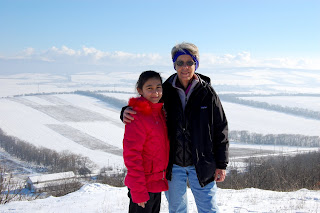
Grace and Safie.
Making snow angels.

Neshet and Safie working on the crossword puzzle.
Life seems to be churning around me these days. The tremendous upheaval in Egypt is in the air everywhere, I think, including here in Crimea/Ukraine where the dissatisfaction with the government grows. The failure of the Orange Revolution in 2004 to reverse the held over Soviet trend towards totalitarianism cumulated in the election of a president last year who has begun to tighten controls on freedom of expression and instituted a number of measures that have had a great affect on the people here. I am not much of a political analyst, especially in an environment in which I have such a limited understanding of the language and culture, but I would have to be completely oblivious to my surroundings to not be aware of people’s anguish about the lack of jobs, the rising gas and food prices, the threatened reduction of pension if one also has a job, an almost absolute necessity when the pension is only $100 a month.
And for the Crimean Tatar people, the change in government has threatened the gains they have made in establishing their lives in Crimea. Though the new president has paid lip service to the idea of settling the “Crimean Tatar problem,” he has at the same time appointed government officials in Crimea who are not favorable to the Crimean Tatars. This morning I attended a very heated meeting o f the library staff about the fact that the library has been without a director for almost a year now. The acting director stepped in when the long time director resigned last year to devote himself full time to the newspaper he publishes. She has done an admirable job, and the staff wants her to be installed as the official director. But apparently the new Minister of Culture (which is the government body libraries function under) does not want her as director and is awaiting orders “from above.” The staff is much concerned about what that means, fearing that the library could be absorbed into the bigger Franco library. To add to those fears, recently the library presented its 5-Year Plan to the Minister of Culture and was told it was the best they received. However, they have failed to post it on their website, only posting the plans of the Franco Library and Orlova, the large children’s library where I work. I couldn’t understand much of the library staff meeting, but I did get that people were angry and wanted to fight back and are sending a letter from the whole staff to the Minister of Culture stating that they want Gulnara (the acting director) to become director.
And last night at the Seiptatiev’s, Serdar sat and talked with me for a long time about the events in Egypt, wondering if something like that could happen in his country or in Russia. He said if people took to the streets in Kiev, that he would go there, that he badly wants to see a change in his country. But he also said he would never get involved in politics, though it is exactly young people like him—passionate, educated, and socially aware—that need to be in politics. Which I pointed out to him, but I also understand his negative feelings about politics, particularly in a country of such corruption. But he is only seventeen—who knows what the future might hold for him.
And on a different note, last weekend my PCV friend Grace came for a visit. We finally got some snow here in Crimea, and we took a walk with Safie up into the bluffs and forest in Ak Mechet. Spent the evening at the Seiptatiev’s talking, playing the dice game of pigs which Grace brought, and Grace working a Russian crossword puzzle with Neshet and Safie. Her greater fluency in Russian is a big help to me in communicating with them, and I try to learn from the experience instead of just getting depressed at how much worse my Russian is!
Starting to think about the summer and the possibility of Serdar going to America with me. There’s a lot to work out—visas (him to go to the US, me to return to Ukraine), money (now that PC is no longer giving a free trip home to those of us who extend), and when and where to go. I just keep telling myself that it will all get worked out, and it will, in whatever way it is meant to be.
Back to work. Thanks to Grace for some great pictures. Love to all from Crimea.

Grace and Safie.

Making snow angels.


Neshet and Safie working on the crossword puzzle.

Life seems to be churning around me these days. The tremendous upheaval in Egypt is in the air everywhere, I think, including here in Crimea/Ukraine where the dissatisfaction with the government grows. The failure of the Orange Revolution in 2004 to reverse the held over Soviet trend towards totalitarianism cumulated in the election of a president last year who has begun to tighten controls on freedom of expression and instituted a number of measures that have had a great affect on the people here. I am not much of a political analyst, especially in an environment in which I have such a limited understanding of the language and culture, but I would have to be completely oblivious to my surroundings to not be aware of people’s anguish about the lack of jobs, the rising gas and food prices, the threatened reduction of pension if one also has a job, an almost absolute necessity when the pension is only $100 a month.
And for the Crimean Tatar people, the change in government has threatened the gains they have made in establishing their lives in Crimea. Though the new president has paid lip service to the idea of settling the “Crimean Tatar problem,” he has at the same time appointed government officials in Crimea who are not favorable to the Crimean Tatars. This morning I attended a very heated meeting o f the library staff about the fact that the library has been without a director for almost a year now. The acting director stepped in when the long time director resigned last year to devote himself full time to the newspaper he publishes. She has done an admirable job, and the staff wants her to be installed as the official director. But apparently the new Minister of Culture (which is the government body libraries function under) does not want her as director and is awaiting orders “from above.” The staff is much concerned about what that means, fearing that the library could be absorbed into the bigger Franco library. To add to those fears, recently the library presented its 5-Year Plan to the Minister of Culture and was told it was the best they received. However, they have failed to post it on their website, only posting the plans of the Franco Library and Orlova, the large children’s library where I work. I couldn’t understand much of the library staff meeting, but I did get that people were angry and wanted to fight back and are sending a letter from the whole staff to the Minister of Culture stating that they want Gulnara (the acting director) to become director.
And last night at the Seiptatiev’s, Serdar sat and talked with me for a long time about the events in Egypt, wondering if something like that could happen in his country or in Russia. He said if people took to the streets in Kiev, that he would go there, that he badly wants to see a change in his country. But he also said he would never get involved in politics, though it is exactly young people like him—passionate, educated, and socially aware—that need to be in politics. Which I pointed out to him, but I also understand his negative feelings about politics, particularly in a country of such corruption. But he is only seventeen—who knows what the future might hold for him.
And on a different note, last weekend my PCV friend Grace came for a visit. We finally got some snow here in Crimea, and we took a walk with Safie up into the bluffs and forest in Ak Mechet. Spent the evening at the Seiptatiev’s talking, playing the dice game of pigs which Grace brought, and Grace working a Russian crossword puzzle with Neshet and Safie. Her greater fluency in Russian is a big help to me in communicating with them, and I try to learn from the experience instead of just getting depressed at how much worse my Russian is!
Starting to think about the summer and the possibility of Serdar going to America with me. There’s a lot to work out—visas (him to go to the US, me to return to Ukraine), money (now that PC is no longer giving a free trip home to those of us who extend), and when and where to go. I just keep telling myself that it will all get worked out, and it will, in whatever way it is meant to be.
Back to work. Thanks to Grace for some great pictures. Love to all from Crimea.
Monday, January 24, 2011
A trip to Kyiv and L'viv with Serdar and Neshet
Serdar taking pictures in Kyiv of the Dneiper River.
Neshet and Serdar having a good time in Kyiv.
On the train to L'viv (before the heat got turned on!).
Building across from our hostel, a typical sight in the old center of L'viv.
City center.
On the hill overlooking the city.
Heading down from the top.
Booksellers are out no matter the weather.
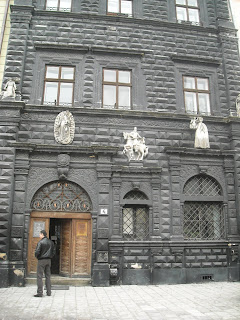
We begin our walk in the snowy cemetery.
The kitchen of our hostel and two American hostel mates.
A stormy night in Crimea, glad to be huddled up in my warm little house—finally warm after returning yesterday morning from being gone for a week to find the temperature in my house 8 degrees Centigrade. It took almost 24 hours for it to warm back up to a reasonable temperature, which makes me not want to turn off the heat when I am gone in the winter, but I know how expensive the gas is here, so I think I can live with a little discomfort.
Last week was an “adventure vacation” with Neshet and Serdar. Serdar and I had talked about going to the western Ukraine city of L’viv during his winter break (which is just one week and is the only break he gets all year!) and when asking Neshet’s permission to go, it was clear he wanted to go too. Somehow, it was important that I ask him, which I did, so the trip turned into a threesome. I so wish Lenura and Safie could have gone too, but Safie was back in school and Lenura had to work. With tears in our eyes, we said that next time just the two (or three) of us would do a trip together.
I needed to go to Kyiv for a day to finish some Peace Corps business, so the plan was to take an overnight train to Kyiv, spend the day there, and then take an overnight train to L’viv and spend two days there, and finally taking the train back to Simferopol, a 24-hour trip. I usually travel 3rd class on the trains because it is cheaper, but Neshet wasn’t too crazy about that idea. So we compromised by traveling 3rd class on the two overnighters and then 2nd class on the long train back to Simferopol. The difference between 2nd and 3rd class is that in 2nd class you are in a closed compartment of four people, and there is more privacy and less people in the train car. But unless you get one of the new train cars, 2nd class isn’t all that much better than 3rd class. In either class, the bathrooms especially have a lot to be desired. But with three of us, it was fun having a compartment to ourselves. The real problem with all the trains in the winter is that they are so hot. There doesn’t seem to be any way to regulate the heat, so we spent a lot of time sweating while watching the snow covered fields go by.
We got to Kyiv early in the morning. Serdar and his dad took off to explore the center, while I went to the Peace Corps office to finish up my last grant and then to the optical store to order a new pair of glasses. I met them around noon in the center, and we spent several more hours walking around, taking some pictures, having something to eat at a cheap cafeteria I knew about. The weather wasn’t great—sort of a cold grey drizzly day—but we enjoyed ourselves anyhow. Serdar had been to Kyiv with me last summer and knew his way around pretty well, and I think was proud to show his dad different sights. Neshet had only been to Kyiv once before, about ten years ago to join protests about the Crimean Tatar reparations. So he hadn’t exactly “seen the sights,” and I think enjoyed visiting the city again.
We took a late afternoon train to L’viv, arriving early in the morning. This train was less crowded and a little less hot, but our area of the car suffered from the lack of light (the bulbs were burned out and hadn’t been replaced) and also the fact that it was right next to the door into the corridor where the bathroom was. So much of the night there was a banging of the door, but I mostly managed to sleep through it.
We took a tram from the train station to our hostel, located in the heart of the city center. L’viv is an expensive city and I knew people who had stayed in this hostel, so it seemed like a reasonable choice for Serdar and me. However, when Neshet decided to come too, I wondered about it. I asked Serdar if he thought his dad would be okay staying in a “dormitory” hostel, and he said yes, but I probably should have known better. He turned out to be very uncomfortable in the hostel and mostly wanted to not spend any time there. And, for him, it wasn’t hard to see why. The hostel is a large, old converted apartment owned by an Australian. There are several rooms which sleep four to twelve people. We were in the ten-bed room, but we were the only three people in it. This is the off season, and though the hostel can accommodate forty people, there were only a total of nine guests while we were there. A large kitchen was the hang out area where you can end up talking to people from all over the world—the real appeal of hostel traveling. But this time there were only Americans and one German. The hostel caters to English speakers and is decorated with Red Army memorabilia, something Westerners would find interesting. But, of course, Neshet is not a westerner. He grew up in the Soviet Union, served in the Red Army, and speaks no English. Furthermore, though he never travels, his idea of traveling is definitely not hostel style. I don’t think we really could have afforded any hotel in the L’viv city center, but whatever we could have found, it might have been a better choice for us. It was a real sort of cross cultural learning experience for me in how I need to think more about the ways my life is so different from someone like Neshet’s and how that impacts even relatively simple things like choices in traveling accommodations.
But despite the less than desirable living arrangement, the three of us had a nice time exploring the wonderful old historic city of L’viv. The weather continued to be cold and gloomy, and the second day, there was such a thick wet snow, that I ended up buying an umbrella to try to stay dry. We walked around the historic district, climbed to the top of a hill where there are the remnants of an ancient fort and great views of the city; climbed again to the top of a bell tower also with great views; went to a “weapons” museum (which Neshet and Serdar found interesting and I found appalling—a history of man’s quest to kill one another); watched the ice skaters on a rink in the center and wanted to go but there were no rental skates available (that would have been interesting—neither Neshet or Serdar have ever ice skated); and walked in the falling snow through a famous old cemetery where the Ukrainian writer Ivan Franko is buried among other luminaries. In between our walking around we found cafes to get out of the weather and warm up and a cafeteria down the street from the hostel provided food that fit our budget. The 24-hour train ride back home was long, but we had the compartment to ourselves and spent the time playing cards, sleeping, reading, talking, and watching the snow covered forests passing by. Serdar and I joked around a lot and also had some great conversations about life in America and about my life in particular, which made me feel even closer to him.
It’s Monday morning now, and I am back at the library, and once again, wondering about exactly what is going on around me. Everyone seems to be working on future ideas for the library, but I can’t really follow all the conversations. I will continue to do the work I know best here—English teaching, blog writing, grant writing—and am fairly content with that, but I will keep searching for other opportunities for different projects. Sometimes I think the Peace Corps is just about keeping busy. It’s hard to imagine what a difference it would make if I could understand the language, but I have become more accepting of working within these limitations.
Back to my work, such as it is. Love to all from Crimea.

Neshet and Serdar having a good time in Kyiv.

On the train to L'viv (before the heat got turned on!).

Building across from our hostel, a typical sight in the old center of L'viv.

City center.

On the hill overlooking the city.

Heading down from the top.

Booksellers are out no matter the weather.


We begin our walk in the snowy cemetery.

The kitchen of our hostel and two American hostel mates.

A stormy night in Crimea, glad to be huddled up in my warm little house—finally warm after returning yesterday morning from being gone for a week to find the temperature in my house 8 degrees Centigrade. It took almost 24 hours for it to warm back up to a reasonable temperature, which makes me not want to turn off the heat when I am gone in the winter, but I know how expensive the gas is here, so I think I can live with a little discomfort.
Last week was an “adventure vacation” with Neshet and Serdar. Serdar and I had talked about going to the western Ukraine city of L’viv during his winter break (which is just one week and is the only break he gets all year!) and when asking Neshet’s permission to go, it was clear he wanted to go too. Somehow, it was important that I ask him, which I did, so the trip turned into a threesome. I so wish Lenura and Safie could have gone too, but Safie was back in school and Lenura had to work. With tears in our eyes, we said that next time just the two (or three) of us would do a trip together.
I needed to go to Kyiv for a day to finish some Peace Corps business, so the plan was to take an overnight train to Kyiv, spend the day there, and then take an overnight train to L’viv and spend two days there, and finally taking the train back to Simferopol, a 24-hour trip. I usually travel 3rd class on the trains because it is cheaper, but Neshet wasn’t too crazy about that idea. So we compromised by traveling 3rd class on the two overnighters and then 2nd class on the long train back to Simferopol. The difference between 2nd and 3rd class is that in 2nd class you are in a closed compartment of four people, and there is more privacy and less people in the train car. But unless you get one of the new train cars, 2nd class isn’t all that much better than 3rd class. In either class, the bathrooms especially have a lot to be desired. But with three of us, it was fun having a compartment to ourselves. The real problem with all the trains in the winter is that they are so hot. There doesn’t seem to be any way to regulate the heat, so we spent a lot of time sweating while watching the snow covered fields go by.
We got to Kyiv early in the morning. Serdar and his dad took off to explore the center, while I went to the Peace Corps office to finish up my last grant and then to the optical store to order a new pair of glasses. I met them around noon in the center, and we spent several more hours walking around, taking some pictures, having something to eat at a cheap cafeteria I knew about. The weather wasn’t great—sort of a cold grey drizzly day—but we enjoyed ourselves anyhow. Serdar had been to Kyiv with me last summer and knew his way around pretty well, and I think was proud to show his dad different sights. Neshet had only been to Kyiv once before, about ten years ago to join protests about the Crimean Tatar reparations. So he hadn’t exactly “seen the sights,” and I think enjoyed visiting the city again.
We took a late afternoon train to L’viv, arriving early in the morning. This train was less crowded and a little less hot, but our area of the car suffered from the lack of light (the bulbs were burned out and hadn’t been replaced) and also the fact that it was right next to the door into the corridor where the bathroom was. So much of the night there was a banging of the door, but I mostly managed to sleep through it.
We took a tram from the train station to our hostel, located in the heart of the city center. L’viv is an expensive city and I knew people who had stayed in this hostel, so it seemed like a reasonable choice for Serdar and me. However, when Neshet decided to come too, I wondered about it. I asked Serdar if he thought his dad would be okay staying in a “dormitory” hostel, and he said yes, but I probably should have known better. He turned out to be very uncomfortable in the hostel and mostly wanted to not spend any time there. And, for him, it wasn’t hard to see why. The hostel is a large, old converted apartment owned by an Australian. There are several rooms which sleep four to twelve people. We were in the ten-bed room, but we were the only three people in it. This is the off season, and though the hostel can accommodate forty people, there were only a total of nine guests while we were there. A large kitchen was the hang out area where you can end up talking to people from all over the world—the real appeal of hostel traveling. But this time there were only Americans and one German. The hostel caters to English speakers and is decorated with Red Army memorabilia, something Westerners would find interesting. But, of course, Neshet is not a westerner. He grew up in the Soviet Union, served in the Red Army, and speaks no English. Furthermore, though he never travels, his idea of traveling is definitely not hostel style. I don’t think we really could have afforded any hotel in the L’viv city center, but whatever we could have found, it might have been a better choice for us. It was a real sort of cross cultural learning experience for me in how I need to think more about the ways my life is so different from someone like Neshet’s and how that impacts even relatively simple things like choices in traveling accommodations.
But despite the less than desirable living arrangement, the three of us had a nice time exploring the wonderful old historic city of L’viv. The weather continued to be cold and gloomy, and the second day, there was such a thick wet snow, that I ended up buying an umbrella to try to stay dry. We walked around the historic district, climbed to the top of a hill where there are the remnants of an ancient fort and great views of the city; climbed again to the top of a bell tower also with great views; went to a “weapons” museum (which Neshet and Serdar found interesting and I found appalling—a history of man’s quest to kill one another); watched the ice skaters on a rink in the center and wanted to go but there were no rental skates available (that would have been interesting—neither Neshet or Serdar have ever ice skated); and walked in the falling snow through a famous old cemetery where the Ukrainian writer Ivan Franko is buried among other luminaries. In between our walking around we found cafes to get out of the weather and warm up and a cafeteria down the street from the hostel provided food that fit our budget. The 24-hour train ride back home was long, but we had the compartment to ourselves and spent the time playing cards, sleeping, reading, talking, and watching the snow covered forests passing by. Serdar and I joked around a lot and also had some great conversations about life in America and about my life in particular, which made me feel even closer to him.
It’s Monday morning now, and I am back at the library, and once again, wondering about exactly what is going on around me. Everyone seems to be working on future ideas for the library, but I can’t really follow all the conversations. I will continue to do the work I know best here—English teaching, blog writing, grant writing—and am fairly content with that, but I will keep searching for other opportunities for different projects. Sometimes I think the Peace Corps is just about keeping busy. It’s hard to imagine what a difference it would make if I could understand the language, but I have become more accepting of working within these limitations.
Back to my work, such as it is. Love to all from Crimea.
Monday, January 10, 2011
A little trip with Nadjie
Muzafer and Nadjie talk to old classmates in Russia via skype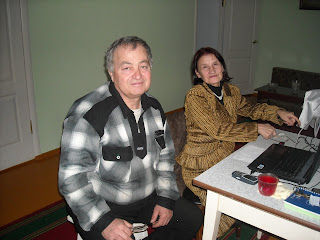
From left--Zera, me, PCV Rosa, Tamara, Nadjie

Tamara and Zera (on right) proudly display their manti dough.
I take a hesitant spin around the ice rink in Simferopol.
The various holiday gatherings are over, and I am back at work, trying to stay awake after a somewhat sleepless weekend. I do have some new ideas on grant pursuing that I want to tackle, but my brain is just too fuzzy and tired right now to do much of anything. So, instead I will write a blog post. For those of you out there reading this know that it comes from a hazy place in my mind. No telling what I might write.
Anyhow, the reason I am so tired is the past weekend I went with Nadjie to visit her childhood friend who lives in a village about two hours from here. The traveling arrangements around such things are frequently a mystery to me, and this was no exception. The reason for the gathering was sort of a “class reunion.” Nadjie’s friend Zera had tracked down one of their old classmates who now lives in Donesk, a large Ukrainian city about a ten hour train ride from Zera’s village. Also coming was Muzafer who lives in Bakcherseray near Simferopol. He has a car and offered to drive and pick Nadjie and me up in the city. That was great, except that for some reason, he wanted to go at 7 in the morning, which meant for me getting up about 5:30 am. And then there was his car—a very beat up old Lada, the Soviet built cars which are ubiquitous here. No seat belts, no heat, one of the windows wedged shut with a piece of wood. When we got to the village, Zera’s brother looked at the car and said, “You drove that all the way from Bakcherseray?” But it did chug right along, and of course, I have learned somewhat to suspend all my safety fears while traveling here. You just have to trust you will make it where you are going, or not…. But, really, it doesn’t seem there are as many car accidents as there are in America, despite the condition of many of the cars and the roads. Probably because most people travel by bus.
So about the reunion—because the schools here and in the former Soviet Union are not divided between elementary, middle, and high schools, and also because people don’t move around so much, students are with the same small group of about 20 students for their entire eleven years of schooling. The bonds they form with each other are immense and can last their lifetimes. In Nadjie and Zera’s case, the village where they lived in Uzbekistan had two schools—one for the Uzbek speaking children, and one for all the Russian speaking children, who consisted of Crimean Tatars, Russians, Koreans, and other ethnic groups. So, their classmates ended up being a diverse group and many of them are Russian. After the Tatars returned to Crimea, they lost track of each other, but Zera decided to see who she could find via the internet and last summer they all met in Russia. Nadjie and Muzafir were unable to attend (Nadjie couldn’t afford it and probably neither could Muzafir), so Zera had a little Crimea gathering and invited Tamara down from Donesk. And she also invited me because we had met the previous summer, and she wanted me come visit her in Sovetski (her village). Zera teaches English at the local Crimean Tatar school and is one of only two older Crimean Tatars that I have met who speak English. Two Peace Corps Volunteers—Rosa and my older PCV buddy Cheryl --who live in Sovetski also joined us later in the day.
It was very enjoyable being there in Zera’s home. Just having the opportunity to be with Nadjie outside of work was a treat in itself, but also I enjoyed so much getting to know Zera a bit more—helping her make manti, talking about her life in Uzbekistan. And one of the things that came out of the weekend is that Zera and I might go to Uzbekistan sometime in the future. I told her how I wanted to go there and see what it is like, as most of the people I know are from there. She loves to travel and said we should go together, though not this year as her daughter is getting married. I have no idea what it would be like to travel with her, but going to Uzbekistan with someone who is from there and speaks English would be my ideal. So, we’ll see. Maybe by the time we actually might go, I will know her much better.
I walked some around the village with Cheryl and saw where she lived—she has a room in an apartment with a woman and her 16-year-old daughter. Not an untypical living arrangement for a PCV, and she seems fine with it, though Cheryl is one of those individuals who seem to be able to adapt to almost anything. A great gift, I think, and especially important in being a PCV! Nadjie and I stayed the night, and I stayed at Rosa’s, who has her own apartment. Rosa has been in Sovetski over a year now and knows Zera quite well and is a very good Russian speaker. Once again, I was struck by the difference in language learning between young and older (Cheryl and I) volunteers.
We rattled back home in the old Lada on Sunday, and I got back out to my house around 1. Took a long walk up into the forest to see if the distant mountains had snow on them—which they do—and then went over to Maia’s for a bit. Her mother died last week, and I wanted to see her again and see how she was doing. As always, I didn’t know quite what the proper tradition is in these circumstances, but for once, I got it right, as all afternoon a string of sympathizers came by the house. Spent last evening over at the Seytaptiev’s, helping Lenura make cheburek and later playing cards with Neshet and Serdar. Oh, and I almost forgot, on Friday (which was a holiday—the Orthodox Christmas), I went into the city center with Lenura and Safie to go ice skating and afterwards for coffee and cake.
So it was a great weekend in many ways, being with the people I love so much. But when I was walking up in the forest, it struck me how my life here is more than becoming close to my neighbors and Nadjie and other women from the library. It is also becoming part of a community of people that have a rich and tragic history and to which I am feeling more and more bound. It is very hard to imagine coming back to America and living in a world that doesn’t encompass the Crimean Tatars.
With love from Crimea.

From left--Zera, me, PCV Rosa, Tamara, Nadjie


Tamara and Zera (on right) proudly display their manti dough.

I take a hesitant spin around the ice rink in Simferopol.

The various holiday gatherings are over, and I am back at work, trying to stay awake after a somewhat sleepless weekend. I do have some new ideas on grant pursuing that I want to tackle, but my brain is just too fuzzy and tired right now to do much of anything. So, instead I will write a blog post. For those of you out there reading this know that it comes from a hazy place in my mind. No telling what I might write.
Anyhow, the reason I am so tired is the past weekend I went with Nadjie to visit her childhood friend who lives in a village about two hours from here. The traveling arrangements around such things are frequently a mystery to me, and this was no exception. The reason for the gathering was sort of a “class reunion.” Nadjie’s friend Zera had tracked down one of their old classmates who now lives in Donesk, a large Ukrainian city about a ten hour train ride from Zera’s village. Also coming was Muzafer who lives in Bakcherseray near Simferopol. He has a car and offered to drive and pick Nadjie and me up in the city. That was great, except that for some reason, he wanted to go at 7 in the morning, which meant for me getting up about 5:30 am. And then there was his car—a very beat up old Lada, the Soviet built cars which are ubiquitous here. No seat belts, no heat, one of the windows wedged shut with a piece of wood. When we got to the village, Zera’s brother looked at the car and said, “You drove that all the way from Bakcherseray?” But it did chug right along, and of course, I have learned somewhat to suspend all my safety fears while traveling here. You just have to trust you will make it where you are going, or not…. But, really, it doesn’t seem there are as many car accidents as there are in America, despite the condition of many of the cars and the roads. Probably because most people travel by bus.
So about the reunion—because the schools here and in the former Soviet Union are not divided between elementary, middle, and high schools, and also because people don’t move around so much, students are with the same small group of about 20 students for their entire eleven years of schooling. The bonds they form with each other are immense and can last their lifetimes. In Nadjie and Zera’s case, the village where they lived in Uzbekistan had two schools—one for the Uzbek speaking children, and one for all the Russian speaking children, who consisted of Crimean Tatars, Russians, Koreans, and other ethnic groups. So, their classmates ended up being a diverse group and many of them are Russian. After the Tatars returned to Crimea, they lost track of each other, but Zera decided to see who she could find via the internet and last summer they all met in Russia. Nadjie and Muzafir were unable to attend (Nadjie couldn’t afford it and probably neither could Muzafir), so Zera had a little Crimea gathering and invited Tamara down from Donesk. And she also invited me because we had met the previous summer, and she wanted me come visit her in Sovetski (her village). Zera teaches English at the local Crimean Tatar school and is one of only two older Crimean Tatars that I have met who speak English. Two Peace Corps Volunteers—Rosa and my older PCV buddy Cheryl --who live in Sovetski also joined us later in the day.
It was very enjoyable being there in Zera’s home. Just having the opportunity to be with Nadjie outside of work was a treat in itself, but also I enjoyed so much getting to know Zera a bit more—helping her make manti, talking about her life in Uzbekistan. And one of the things that came out of the weekend is that Zera and I might go to Uzbekistan sometime in the future. I told her how I wanted to go there and see what it is like, as most of the people I know are from there. She loves to travel and said we should go together, though not this year as her daughter is getting married. I have no idea what it would be like to travel with her, but going to Uzbekistan with someone who is from there and speaks English would be my ideal. So, we’ll see. Maybe by the time we actually might go, I will know her much better.
I walked some around the village with Cheryl and saw where she lived—she has a room in an apartment with a woman and her 16-year-old daughter. Not an untypical living arrangement for a PCV, and she seems fine with it, though Cheryl is one of those individuals who seem to be able to adapt to almost anything. A great gift, I think, and especially important in being a PCV! Nadjie and I stayed the night, and I stayed at Rosa’s, who has her own apartment. Rosa has been in Sovetski over a year now and knows Zera quite well and is a very good Russian speaker. Once again, I was struck by the difference in language learning between young and older (Cheryl and I) volunteers.
We rattled back home in the old Lada on Sunday, and I got back out to my house around 1. Took a long walk up into the forest to see if the distant mountains had snow on them—which they do—and then went over to Maia’s for a bit. Her mother died last week, and I wanted to see her again and see how she was doing. As always, I didn’t know quite what the proper tradition is in these circumstances, but for once, I got it right, as all afternoon a string of sympathizers came by the house. Spent last evening over at the Seytaptiev’s, helping Lenura make cheburek and later playing cards with Neshet and Serdar. Oh, and I almost forgot, on Friday (which was a holiday—the Orthodox Christmas), I went into the city center with Lenura and Safie to go ice skating and afterwards for coffee and cake.
So it was a great weekend in many ways, being with the people I love so much. But when I was walking up in the forest, it struck me how my life here is more than becoming close to my neighbors and Nadjie and other women from the library. It is also becoming part of a community of people that have a rich and tragic history and to which I am feeling more and more bound. It is very hard to imagine coming back to America and living in a world that doesn’t encompass the Crimean Tatars.
With love from Crimea.
Tuesday, January 4, 2011
Celebrating New Year 2011 in Crimea
Lenura with some of the New Year's feast she prepared (I made nori rolls).
English Club at the Krumchak Museum.
With Refika and Nadjie at the library.
The Christmas celebration with the volunteers (and one Ukrainian--guess who?)
A typical PCV scene.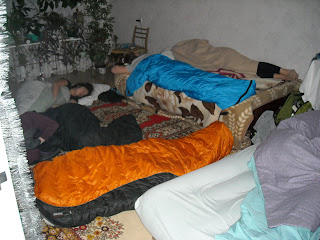
Tuesday morning at the library—seems like I often begin my posts this way. It is a snowy morning and our first day back to work after the New Year holiday weekend. This week, too, is a short work week, as Friday January 7th is the Orthodox Christian Christmas, and the library will be closed because it is a national holiday (no separation of church and state here!). However, almost no one I know celebrates it, or at least the people I am in direct contact with don’t. When I inquired this morning at our English class whether or not to have the English Club Thursday night (which would be Christmas Eve in the American Christmas tradition), everyone said sure, why not? I do think there are a few Christians in the group, but mostly everyone is either Muslim or Jewish, and maybe even the Christians don’t celebrate Christmas. We’ll see who shows up…
Anyhow, I have started a few blog posts in the last week or so, but they have all been a bit dismal, concerned with my ongoing battle with language (oh no, not that topic again!) and not feeling physically great. But I decided to put them away and write a more positive blog about all the New Year celebrating that went on last weekend. Or at least my part in the celebrating. Which started with my English Club last Thursday evening. We had decided at the previous meeting to have a little celebration and try to sing holiday songs in English! So I made them song books (Jingle Bells, Deck the Halls, Rudolph the Red Nosed Reindeer, etc) and bought some candy. Unfortunately, most of the participants from the Gasprinskiy Library couldn’t come for various reasons, so just Zarema and I walked over to the Krymchak museum after work. And to our surprise, the women at the museum had laid out a whole spread of food, complete with wine for the traditional toasting. We had a great time: eating, toasting, trying to sing the songs, and listening to Nina (director of the museum) play the piano and sing her own compositions in her rich alto voice. And at some point, going on a tour of the small museum, which I had seen before, but was happy to see again and understand more about who the Krymchak people are.
The next day, Friday, was Dec. 31st. Usually I don’t go into the library on Fridays, but Nadjie asked me to come because they would be having their annual New Year celebration, which I didn’t get to attend last year because of being at the Children’s Library on that day. I definitely wanted to celebrate at Gasprinskiy this year, so was happy to oblige her request. We all gathered in the reading hall for champagne and candy and many toasts. A man I see around here a lot but who isn’t on the staff—not quite sure what his role is here—got up and sang Crimean Tatar songs in a powerful operatic voice. I think he might be retired now, but clearly at some point in his life, he was a professional singer. Afterwards, the director gave each of us a present—mostly a bottle of champagne—and people got up and said a few words. When I got up, the director of the library asked me to sing an English holiday song for them—yikes!! But, I rallied and managed a rendition of Auld Lang Syne, and hoped all would forgive my off key singing.
I spent that evening—New Year’s Eve-- over at the Seytaptiev’s. Unlike the holiday in America, New Year’s Eve is more of a time to spend with the family, much like Christmas in America, with a big traditional meal, presents, a Christmas tree, and then combined with a New Year celebration of champagne toasts and fireworks at midnight. Oh, and the president always comes on TV at midnight to give a welcoming speech for the New Year! There was much laughter at the Seytaptiev’s this year as they watched the new president, because he only spoke for about 5 minutes, whereas in the past the president usually delivered at least a 15 minute speech. They attributed his short speech to the fact that he barely speaks Ukrainian, the national language, and 5 minutes was the most he could muster. But he did remind everyone that 2011 is the 20th anniversary of the founding of the independent country of Ukraine, despite the ancientness of the land. (Kyiv, the capital, was founded in 1000 AD).
I have heard a couple of versions as to why New Year’s is such a big holiday here, both to do with restrictions under the Soviet Union. One explanation is that all other holidays were political events, so people went all out for a holiday that didn’t represent the end of the war, the workers revolution, etc. Also, religious celebrations were banned, so New Year’s took the place of what would be a Christmas celebration. But whatever the reason, it is firmly established as the big holiday in Ukraine.
A couple of more celebrations followed New Year’s Eve—eating a big dinner with Maiye and Server the next day, a lunch with my tutor and her husband on Monday where Givi (the husband) made the lunch, including a famous Georgian dish composed of chicken, garlic, walnut paste, and cilantro (he’s from Georgia). Champagne toasts accompanied all the meals, but I did at least avoid the vodka toasts!
I almost forgot my American Christmas. I celebrated it with twelve other Peace Corps Volunteers in a PCV’s large apartment in a village a 2-hour bus ride from here. Turkey dinner, stockings with candy and oranges, little white elephant gifts, and some champagne toasting too! It was fun, and I am glad I went and was especially glad to spend some time with my few PCV friends here in Crimea.
Well, I think that is it for my holiday saga. I long to be off in the forest somewhere, or talking with Serdar about the new adventures in his life, or just lying at home finishing a book I have recently gotten absorbed in, but I am here, “at work,” and will try to get something at least somewhat productive done. Happy New Year to all my friends back in America from your pal in the Crimea.

English Club at the Krumchak Museum.

With Refika and Nadjie at the library.

The Christmas celebration with the volunteers (and one Ukrainian--guess who?)

A typical PCV scene.

Tuesday morning at the library—seems like I often begin my posts this way. It is a snowy morning and our first day back to work after the New Year holiday weekend. This week, too, is a short work week, as Friday January 7th is the Orthodox Christian Christmas, and the library will be closed because it is a national holiday (no separation of church and state here!). However, almost no one I know celebrates it, or at least the people I am in direct contact with don’t. When I inquired this morning at our English class whether or not to have the English Club Thursday night (which would be Christmas Eve in the American Christmas tradition), everyone said sure, why not? I do think there are a few Christians in the group, but mostly everyone is either Muslim or Jewish, and maybe even the Christians don’t celebrate Christmas. We’ll see who shows up…
Anyhow, I have started a few blog posts in the last week or so, but they have all been a bit dismal, concerned with my ongoing battle with language (oh no, not that topic again!) and not feeling physically great. But I decided to put them away and write a more positive blog about all the New Year celebrating that went on last weekend. Or at least my part in the celebrating. Which started with my English Club last Thursday evening. We had decided at the previous meeting to have a little celebration and try to sing holiday songs in English! So I made them song books (Jingle Bells, Deck the Halls, Rudolph the Red Nosed Reindeer, etc) and bought some candy. Unfortunately, most of the participants from the Gasprinskiy Library couldn’t come for various reasons, so just Zarema and I walked over to the Krymchak museum after work. And to our surprise, the women at the museum had laid out a whole spread of food, complete with wine for the traditional toasting. We had a great time: eating, toasting, trying to sing the songs, and listening to Nina (director of the museum) play the piano and sing her own compositions in her rich alto voice. And at some point, going on a tour of the small museum, which I had seen before, but was happy to see again and understand more about who the Krymchak people are.
The next day, Friday, was Dec. 31st. Usually I don’t go into the library on Fridays, but Nadjie asked me to come because they would be having their annual New Year celebration, which I didn’t get to attend last year because of being at the Children’s Library on that day. I definitely wanted to celebrate at Gasprinskiy this year, so was happy to oblige her request. We all gathered in the reading hall for champagne and candy and many toasts. A man I see around here a lot but who isn’t on the staff—not quite sure what his role is here—got up and sang Crimean Tatar songs in a powerful operatic voice. I think he might be retired now, but clearly at some point in his life, he was a professional singer. Afterwards, the director gave each of us a present—mostly a bottle of champagne—and people got up and said a few words. When I got up, the director of the library asked me to sing an English holiday song for them—yikes!! But, I rallied and managed a rendition of Auld Lang Syne, and hoped all would forgive my off key singing.
I spent that evening—New Year’s Eve-- over at the Seytaptiev’s. Unlike the holiday in America, New Year’s Eve is more of a time to spend with the family, much like Christmas in America, with a big traditional meal, presents, a Christmas tree, and then combined with a New Year celebration of champagne toasts and fireworks at midnight. Oh, and the president always comes on TV at midnight to give a welcoming speech for the New Year! There was much laughter at the Seytaptiev’s this year as they watched the new president, because he only spoke for about 5 minutes, whereas in the past the president usually delivered at least a 15 minute speech. They attributed his short speech to the fact that he barely speaks Ukrainian, the national language, and 5 minutes was the most he could muster. But he did remind everyone that 2011 is the 20th anniversary of the founding of the independent country of Ukraine, despite the ancientness of the land. (Kyiv, the capital, was founded in 1000 AD).
I have heard a couple of versions as to why New Year’s is such a big holiday here, both to do with restrictions under the Soviet Union. One explanation is that all other holidays were political events, so people went all out for a holiday that didn’t represent the end of the war, the workers revolution, etc. Also, religious celebrations were banned, so New Year’s took the place of what would be a Christmas celebration. But whatever the reason, it is firmly established as the big holiday in Ukraine.
A couple of more celebrations followed New Year’s Eve—eating a big dinner with Maiye and Server the next day, a lunch with my tutor and her husband on Monday where Givi (the husband) made the lunch, including a famous Georgian dish composed of chicken, garlic, walnut paste, and cilantro (he’s from Georgia). Champagne toasts accompanied all the meals, but I did at least avoid the vodka toasts!
I almost forgot my American Christmas. I celebrated it with twelve other Peace Corps Volunteers in a PCV’s large apartment in a village a 2-hour bus ride from here. Turkey dinner, stockings with candy and oranges, little white elephant gifts, and some champagne toasting too! It was fun, and I am glad I went and was especially glad to spend some time with my few PCV friends here in Crimea.
Well, I think that is it for my holiday saga. I long to be off in the forest somewhere, or talking with Serdar about the new adventures in his life, or just lying at home finishing a book I have recently gotten absorbed in, but I am here, “at work,” and will try to get something at least somewhat productive done. Happy New Year to all my friends back in America from your pal in the Crimea.
Subscribe to:
Posts (Atom)