I’m back in Crimea now, in my new home with the Seytaptiev’s. Though my thoughts at the moment seem consumed by adjusting to this new reality in my life and wondering what to make of it, I want to try first to put down a few words about what it was like to be in America after being gone for over two years.
On this first trip back, I wanted to make as big an effort as possible to see friends and family. And though I didn’t quite succeed in seeing everyone I wanted to, I came pretty close. But it was an exhausting endeavor at times, though mostly just in Minneapolis. In California and Chicago I have only been a visitor, but, of course, Minneapolis was my home for so many years and still is my home in many ways. Leaving there at the end of my visit felt a lot like the first time I left for the Peace Corps—saying goodbye to dear friends that I didn’t know when I would see again.
So what was it like to be in America?—a constant question everywhere I went. My initial reaction was it was just comfortable, familiar—it was home. I could understand the language (!), I knew how to get around, how to get directions when I needed them, how to ask for help; I could understand what it meant when some person did what in a culture I am less familiar with might be considered strange behavior. And it is just so much easier to live in America. It is much cleaner, for one thing—people are well trained to put their trash in garbage cans and the garbage is picked up on a regular basis (I realize there are exceptions to this, but unlike here, they are exceptions, not the rule). People are friendlier—at least to this white, older middle class woman—clerks in the store smile and greet you when you come in; the woman at the bank goes out of her way to help you; strangers constantly offer to take a picture of the “two of you” as I walk around with my camera and a friend. People on the street just appear more cheerful, more hopeful, more ready to smile and laugh—and all of this in spite of the disheartening political situation and the lack of jobs that many people face.
And of course, it is America, one of the richest countries in the world, and that evidence is everywhere—gleaming modern high rise buildings in the cities, well built and maintained highways in the countryside, airports filled with shops and restaurants, advertisements for the newest techno gadget broadcasting from billboards and the omnipresent television and internet. But I began to see ways in which it isn’t so easy to live there. The first time I went to my local grocery store—not even a supermarket but my neighborhood food coop—I was suddenly overwhelmed by all the choices presented to me when all I wanted was some simple bread and cheese. People all over the world are hungry for the possibilities those choices contain, but it occurred to me how much stress that introduces into one’s life—the constant decision making in even inconsequential situations. We Americans just become used to it, of course, and don’t always like it when the choices are absent, but it seemed to me that they take up a huge amount of psychic space and I found myself longing for the simpler life here in Crimea—where there are still many choices, of course, but not AS many, and for me, of course, they are limited by my language abilities.
As time went on in America, I found more disturbing aspects of life there, ways of living that are the “American life:” the busyness of peoples’ schedules which makes it difficult to find time just to be together; the annoyance of the constant leaving of messages on the answering machine and cell phone; the frenzy of the freeways and the airports. `It seems we pay a price for the ease of our life in America, though now that I have returned to Crimea, I wonder if it is a price I am once again willing to pay. But more on that in a future blog.
What I really learned from my month long trip to America, is that the old adage “home is where the heart is” is so very true. As I basked in the love of my friends and family in America, I also yearned for my friends and “family” in Crimea. I tried to stay as connected as I could, but as always, I found the attempt to communicate in Russian on the telephone so daunting that eventually I mostly just talked with Serdar and briefly with Nadjie as I tried to stay on top of what was happening with her health. I came to realize that ultimately it didn’t really matter where I lived, as long as I can live near the people I love. But, of course, those people have expanded to include people who live thousands of miles and worlds apart. And so that is the dilemma I now struggle with— where exactly is my home?
Thursday, September 1, 2011

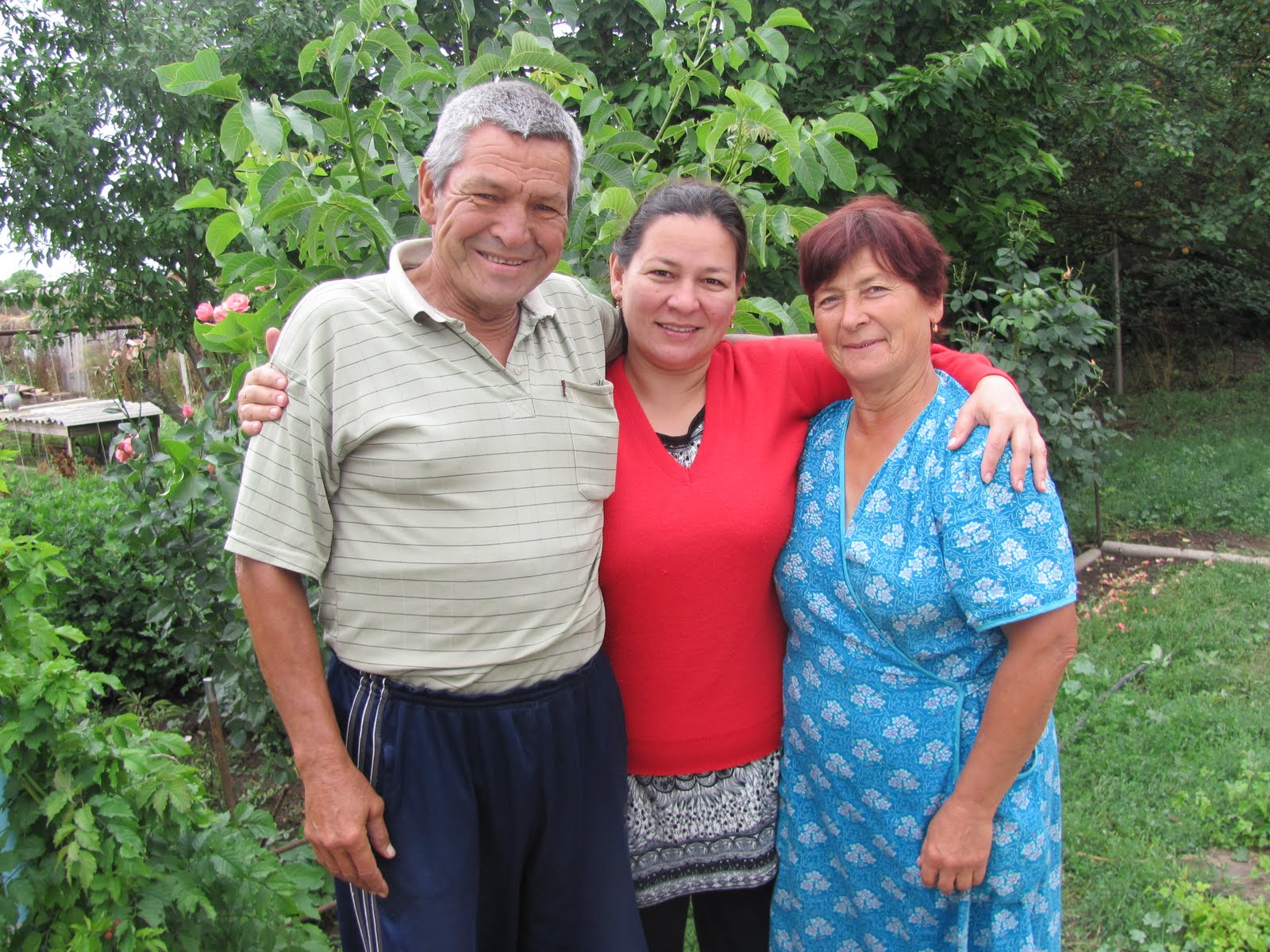
With the Seytaptiev's before America

July 22, 2011—Well, here I am in America, writing this blog post on my friend Kate’s netbook. Hard to remember what I was doing last week at this time in Crimea—that world seems so far away. But I do have vivid memories of last Saturday when the family and I spent the day together. Safie so wanted to “go to the sea,” so she asked her dad if we could all go on Saturday. I was glad to hear him agree, because of course I always want to go to the sea, but more because it means he would allow himself a day off from the relentless summer house projects which lately has included a very elaborate fence design—more on that in future blogs. I was very disappointed to learn that Lenura had to work and wouldn’t be able to come with us, but Saturday morning when we finally took off with me in the front seat and Serdar and Safie in the back, I was so happy when we swung by the hospital where Lenura works and picked her up to go with us. Somehow she had figured out to leave work early, because she too wanted a last day of all of us together.
As usual, I didn’t know exactly where Neshet had in mind to go, but I was pleased when he turned east when we got to the Black Sea coast. I had never been on that stretch of the coast before—one of the few areas of the Crimea I haven’t explored. It is a much less developed area with fewer seaside villages and the mountain slopes covered in vineyards and steep pastures. We drove around Demerji Mountain with a different view of its strange rock formations on the summit. The road curled on the cliffs high above the sea, dipping down to pass through seaside villages crowded with tourists. I kept hearing the family discussing our destination, which turned out to be a village called Rebachne. It started to pour down rain as we pulled into a parking space above the beach. We waited in the steamy car until the rain quit and then headed down to the beach and spread out our blanket. There weren’t many people, the water was beautiful and clear, and refreshingly cool on this hot and humid day. I thought we had finally found an uncrowded beach, but later on I realized it was the weather that had kept the beach so empty, as it quickly filled up when the sun came out. But I didn’t care as I dove and swam and played with Serdar and Safie and Lenura in the waves. Neshet, meanwhile, took a swim far out into the sea, came back, and immediately laid down on the blanket and fell asleep. It was great to see him relax so.
After spending the whole afternoon there, including a foray out on a paddle boat with Serdar and Safie, we packed up just before another rain squall came in and headed back to Simferopol. As we got to the edge of the city, I was surprised to hear Neshet saying something about stopping at a Crimean Tatar restaurant for dinner. Eating out at a restaurant is a very unusual thing for them—I think I have only once before been with them at a restaurant and that was when Pat and I took them out for dinner. So this was a special occasion indeed—a send off celebration for me. And the restaurant was, as Serdar told me, the fanciest of the Crimean Tatar restaurants. Named Ayshe, it was very lovely with a large outside seating area that wound through tall trees and was interspersed with beautiful fountains. A wedding celebration was going on, but mostly inside one of the dining rooms, so we had a quiet spot under a canopy and a good place to observe the wedding party, much to Safie’s delight. We arrived home late, filled with the warmth of the sun on the beach, tired from swimming in the beautiful Black Sea, and our stomachs full of yummy Crimea Tatar food.
What a great last day it was for me before my adventure to America. And driving along the coast, feeling the love of this family that has become my family, I started thinking about how perhaps my lack of being able to fully understand the language has allowed me access to a deeper love—that I can find an openness to love in a way that is harder when one is so road blocked by all the annoyances that language creates. Sometimes I think it is really a good thing that I so often don’t understand what is being said around me. Because is it really important? Seems to me what is important is getting beneath that surface of who we are, of relating to someone from a deeper level, from the heart. And I think it is that place that has allowed me to love the Seytaptiev’s, despite the barrier of language.
Tuesday, July 12, 2011
July happenings before going to America
Cheryl on the trail in Novy Svit botanical reserve.


Wine cellar in a cave in the Reserve.


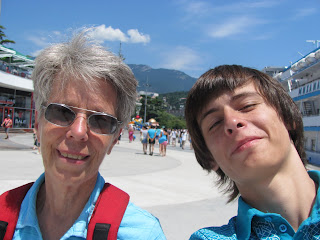
Serdar and I in Yalta.
The Massandra Winery.

Serdar with the Pickle Project ladies, Sarah and Linda.

At the library—my last few days before taking off on my trip to the US. It’s slow here, as it always is in the summer when many people have their month vacation, so I am just trying to get caught up on a few things—like blog posts—before I take off. And struggling a bit with the library about how they can receive the money from the $15,000 grant we were awarded to purchase a rare book scanner. Seems the library is not set up to receive foreign funds, so they will have to set up a separate account and then do a lot of reporting to the Ukrainian government. The accountant for the library is clearly not interested in doing all of this, but I don’t think there is any choice. They wanted me to get the money and then give it to them, but I told them that was not possible. Ah well, like everything here, it will eventually get resolved if one can just stay patient enough.
Have done some adventuring around Crimea since my last post. Cheryl and I did indeed make it to Novy Svit down on the coast a couple of weekends ago. We were to meet at the bus station in Sudak, a two-hour bus ride for me, but as it turned out, a much longer ride for Cheryl due to her pokey bus stopping at every little village. So I spent an hour or so hanging out waiting for her, but having a good time, talking with the women there who meet the buses with apartment rental signs, something you see everywhere on the coast in the summer. Residents of the coastal towns can rent out their apartments to tourists for pretty good rates—we paid $140 a night for a two-bedroom apartment in Yalta last summer—and it is a good source of income for the local people. So good that it is pretty impossible to have Peace Corps Volunteers in the coastal towns, as they tend to get kicked out of their apartments in the summer.
Cheryl eventually showed up, and we took a packed-with-people little bus over the winding coastal road to the little village of Novy Svit--which in the summer is transformed into a beach packed resort--but beautiful, nonetheless. I had heard about a hiking trail through the botanical reserve at the end of the beach and that was our goal. It turned out to be a gorgeous hike along the rocky headlands bordering three lovely blue bays, with deep caves tucked back into the cliff sides. During the Russian Empire time, it was the playground of a wealthy Russian prince, and the remains of his wine storage area are still there. We picnicked in the shade of a large boulder and made our way back through the forest to the town of Novy Svit. I had brought my new swimsuit—a little less bikini than the old one which ended up with a young PCV—and really wanted to go in the water. Cheryl was not too interested, and given that once again, the water was ice cold, she probably made the better choice. A great day it was in yet another amazingly beautiful area of Crimea.
Late Wednesday night, the Pickle Project Ladies—Sarah Crow and Linda Norris—showed up for a 5-day visit in Crimea. They are in the middle of a planning trip for a fall project that will center on understanding culture through conversations about food. Check out their blog—pickleproject.blogspot.com—for lots of interesting information—and pictures—about what they are doing.
I took Thursday off so I could travel around with them and listen in on their food conversations. We took to calling them the “food journalists,” as it was the easiest way to say who they are in Russian. One of the things they wanted to do was go to a winery in Crimea, especially the famous 200-year-old Massandra Winery in the mountains above Yalta. Serdar gladly came along as our interpreter, and off we went on the bus to Yalta. Our excursion started with a walk along the boardwalk in Yalta (Linda had never been there), a pretty bad—but cheap—lunch in an old Soviet style cafeteria on the waterfront, and then an hour tour through the winery in a village close to Yalta. We didn’t actually taste the wine, as it added to the cost of an already high priced tour and none of us were that interested in drinking the wine, more in how it has historically been produced in the deep underground cellars built into the mountainsides. We made our way back to Simferopol on the slowest bus possible, finally getting off short of our destination in Simferopol and walking along the river to a Crimean Tatar restaurant I knew about for a nice dinner of traditional dishes. A great day with the very much added bonus of having the company of Serdar all day.
We spent most of Friday touring the markets and talking with Cheryl and Brian, the returned PCV who is doing an oral history project at the library. Saturday we went to the book market in town and then to the central market for food for our cooking extravaganza with Lenura later that day. Lenura taught Sarah how to make the Crimean Tatar dish manti, including how to roll out the dough, which I find a pretty daunting task. But Sarah got into it and ended up with some fine manti. Linda videotaped the whole process and later interviews with Neshet about his childhood food memories. We had a great meal of manti and two different kinds of salads, wine, and lots of laughter. And me interpreting much of the time! I actually did pretty good—they kept telling me that I sell myself short about my language skills, that I can speak Russian better than I think I can. That was pretty encouraging to hear.
On Sunday—a very hot day—I wanted to go to Bakcherseray to buy presents at the Crimean Tatar crafts cooperative for my friends in America. We combined it with a hike up to the cave city of Chufat Kale. I have been there many times, so I let them make their way up to the plateau and went on past the cave city to an ancient Karim Jewish cemetery I had heard about. And I was so glad I did—it was a deeply peaceful—and cool--place full of tall trees and old moss covered gravestones etched in Hebrew. I only encountered one person there, a young woman who was sitting in the midst of the tombs, quietly concentrating on a drawing she was working on. Standing in the center of the grave covered ravine, you could feel the history there, the centuries of people who have come and gone, the fragileness of existence. I could have spent a long time just sitting there, and maybe one day I will go back and do just that.
It is a couple of days later now. Sarah and Linda left on the train last night for their next destination, Odessa. I am going to try and do some work this week, but mostly I seem to be focusing on present buying and packing up my house for the move to the Seytaptiev’s. And I think my neighbor will be coming home today with her new baby, so that will be a fun event. As the time gets nearer for my trip to the US, I find myself getting more and more excited to see everyone, and also more and more curious about how it will feel to be there and what affect the experience will have on how I feel about staying in Crimea. Right now, Crimea feels like my home, though I expect the familiarity of places, the love of my friends, the understanding of the language will all create a strong pull on my heart and mind. Or maybe not… maybe I will miss my life here so much that I will be anxious to get back. I do know I want to stay in touch as much as I can with Nadjie and the Seytaptiev’s because I know I will miss them, and also it will give me a chance to keep speaking Russian!
Well, this is a very long post and perhaps the last until I return to Crimea. Much love to all and to at least some of you, see you SOON!


Wine cellar in a cave in the Reserve.


Serdar and I in Yalta.

The Massandra Winery.

Serdar with the Pickle Project ladies, Sarah and Linda.

At the library—my last few days before taking off on my trip to the US. It’s slow here, as it always is in the summer when many people have their month vacation, so I am just trying to get caught up on a few things—like blog posts—before I take off. And struggling a bit with the library about how they can receive the money from the $15,000 grant we were awarded to purchase a rare book scanner. Seems the library is not set up to receive foreign funds, so they will have to set up a separate account and then do a lot of reporting to the Ukrainian government. The accountant for the library is clearly not interested in doing all of this, but I don’t think there is any choice. They wanted me to get the money and then give it to them, but I told them that was not possible. Ah well, like everything here, it will eventually get resolved if one can just stay patient enough.
Have done some adventuring around Crimea since my last post. Cheryl and I did indeed make it to Novy Svit down on the coast a couple of weekends ago. We were to meet at the bus station in Sudak, a two-hour bus ride for me, but as it turned out, a much longer ride for Cheryl due to her pokey bus stopping at every little village. So I spent an hour or so hanging out waiting for her, but having a good time, talking with the women there who meet the buses with apartment rental signs, something you see everywhere on the coast in the summer. Residents of the coastal towns can rent out their apartments to tourists for pretty good rates—we paid $140 a night for a two-bedroom apartment in Yalta last summer—and it is a good source of income for the local people. So good that it is pretty impossible to have Peace Corps Volunteers in the coastal towns, as they tend to get kicked out of their apartments in the summer.
Cheryl eventually showed up, and we took a packed-with-people little bus over the winding coastal road to the little village of Novy Svit--which in the summer is transformed into a beach packed resort--but beautiful, nonetheless. I had heard about a hiking trail through the botanical reserve at the end of the beach and that was our goal. It turned out to be a gorgeous hike along the rocky headlands bordering three lovely blue bays, with deep caves tucked back into the cliff sides. During the Russian Empire time, it was the playground of a wealthy Russian prince, and the remains of his wine storage area are still there. We picnicked in the shade of a large boulder and made our way back through the forest to the town of Novy Svit. I had brought my new swimsuit—a little less bikini than the old one which ended up with a young PCV—and really wanted to go in the water. Cheryl was not too interested, and given that once again, the water was ice cold, she probably made the better choice. A great day it was in yet another amazingly beautiful area of Crimea.
Late Wednesday night, the Pickle Project Ladies—Sarah Crow and Linda Norris—showed up for a 5-day visit in Crimea. They are in the middle of a planning trip for a fall project that will center on understanding culture through conversations about food. Check out their blog—pickleproject.blogspot.com—for lots of interesting information—and pictures—about what they are doing.
I took Thursday off so I could travel around with them and listen in on their food conversations. We took to calling them the “food journalists,” as it was the easiest way to say who they are in Russian. One of the things they wanted to do was go to a winery in Crimea, especially the famous 200-year-old Massandra Winery in the mountains above Yalta. Serdar gladly came along as our interpreter, and off we went on the bus to Yalta. Our excursion started with a walk along the boardwalk in Yalta (Linda had never been there), a pretty bad—but cheap—lunch in an old Soviet style cafeteria on the waterfront, and then an hour tour through the winery in a village close to Yalta. We didn’t actually taste the wine, as it added to the cost of an already high priced tour and none of us were that interested in drinking the wine, more in how it has historically been produced in the deep underground cellars built into the mountainsides. We made our way back to Simferopol on the slowest bus possible, finally getting off short of our destination in Simferopol and walking along the river to a Crimean Tatar restaurant I knew about for a nice dinner of traditional dishes. A great day with the very much added bonus of having the company of Serdar all day.
We spent most of Friday touring the markets and talking with Cheryl and Brian, the returned PCV who is doing an oral history project at the library. Saturday we went to the book market in town and then to the central market for food for our cooking extravaganza with Lenura later that day. Lenura taught Sarah how to make the Crimean Tatar dish manti, including how to roll out the dough, which I find a pretty daunting task. But Sarah got into it and ended up with some fine manti. Linda videotaped the whole process and later interviews with Neshet about his childhood food memories. We had a great meal of manti and two different kinds of salads, wine, and lots of laughter. And me interpreting much of the time! I actually did pretty good—they kept telling me that I sell myself short about my language skills, that I can speak Russian better than I think I can. That was pretty encouraging to hear.
On Sunday—a very hot day—I wanted to go to Bakcherseray to buy presents at the Crimean Tatar crafts cooperative for my friends in America. We combined it with a hike up to the cave city of Chufat Kale. I have been there many times, so I let them make their way up to the plateau and went on past the cave city to an ancient Karim Jewish cemetery I had heard about. And I was so glad I did—it was a deeply peaceful—and cool--place full of tall trees and old moss covered gravestones etched in Hebrew. I only encountered one person there, a young woman who was sitting in the midst of the tombs, quietly concentrating on a drawing she was working on. Standing in the center of the grave covered ravine, you could feel the history there, the centuries of people who have come and gone, the fragileness of existence. I could have spent a long time just sitting there, and maybe one day I will go back and do just that.
It is a couple of days later now. Sarah and Linda left on the train last night for their next destination, Odessa. I am going to try and do some work this week, but mostly I seem to be focusing on present buying and packing up my house for the move to the Seytaptiev’s. And I think my neighbor will be coming home today with her new baby, so that will be a fun event. As the time gets nearer for my trip to the US, I find myself getting more and more excited to see everyone, and also more and more curious about how it will feel to be there and what affect the experience will have on how I feel about staying in Crimea. Right now, Crimea feels like my home, though I expect the familiarity of places, the love of my friends, the understanding of the language will all create a strong pull on my heart and mind. Or maybe not… maybe I will miss my life here so much that I will be anxious to get back. I do know I want to stay in touch as much as I can with Nadjie and the Seytaptiev’s because I know I will miss them, and also it will give me a chance to keep speaking Russian!
Well, this is a very long post and perhaps the last until I return to Crimea. Much love to all and to at least some of you, see you SOON!
Friday, July 1, 2011
June happenings



It’s a Friday afternoon, about two weeks since my last blog. Seems like much has been happening lately and it is going to get even more busy these two weeks leading up to my departure for America.
My PC V friend Grace came for a last visit two weekends ago before she took off on a month long trip to Russia and Georgia and then back home to the U.S. She has become quite close with the Seytaptievs over the two years she has been visiting me, so it was a weekend that we spent mostly with them, though the weekend camping trip we had hoped to take didn’t materialize because Lenura had to work some of the time. But on one of the days, Grace and I took off with Serdar and Safie to Balaklava down on the coast. We wanted to go to the beach, and I had just finished reading a novel set during the Crimean War in Balaklava, and I wanted to see the historic town and harbor. Grace had been there but not to the beach, and Serdar and Safie had never been there, so it was an adventure for all of us. A two-hour bus ride to Sevastopol and then a 20-minute taxi ride (because we didn’t know where we were going—we took the city buses on the way back) got us to the town of Balaklava. It is situated around a small harbor that is enclosed by high cliffs with only a narrow opening out to the sea. In more recent times, Balaklava is most famous for the being the location of a secret Soviet submarine factory in an underwater cave set into the cliffs. It is no longer used and is now a museum which at some point I want to visit, but the opening where the submarines came out is very visible.
The beaches in Balaklava are located outside the harbor and you have to take a ferry to get there. The ferry hadn’t started up yet for the season, so we hired a boat to take us out to one of the beaches. It was very beautiful, much like the beaches of northern California, and there weren’t too many people there. Though we soon found out why, and also why the ferry hadn’t started running yet—the water was ice cold—kind of like swimming in the Arctic. Well, really, you couldn’t actually swim—it took your breath away to just get in the water. But it was a beautiful sunny warm day, and it was fun to hang out on the beach together. But even that didn’t last long as the ominous looking clouds we saw in the distance started rolling in. Eventually everyone on the beach gathered under a large tent pavilion as the wind started blowing and the rain came down in torrents. Some people had gone to stand under overhangs from the cliffs, but eventually they had to move into the tent too, as water and gravel came pouring off the top of the cliffs. It was all pretty wild, as we huddled under the tent, trying to stay dry and warm. But the Russians, in their typical fashion, seemed undaunted by the weather, taking it all in stride. Next to us sat a group of picnickers who continued to eat and make vodka toasts and next to them were a group of elderly ladies who were belting out songs. I loved it….
Eventually the rain and wind stopped and we went out to the beach, but the weather had turned cold, so we caught a boat back to the town. Had some dinner in a restaurant on the harbor and then caught the buses back to Simferopol. A really wonderful last trip for Grace with the kids. The next day we made a big dinner over at the Seytaptievs’, played cards and talked late into the night, and then it was time for Grace to say her sad farewells, with me thinking to myself, “I can never do this, I can never leave them like this…” Not sure what that means for my future.
Grace caught the train to Kyiv the next day, and a couple of days later, I also took the overnight train to Kyiv for a two-day meeting about the community development projects (the program I work under) in Ukraine. It was fairly interesting and good to spend time with some of the staff people I like so much, but I was glad to get back to Simferopol and Ak Mechet. Last weekend was a four-day weekend, as Tuesday was Constitution Day (when the Ukrainian constitution was signed) and the government also made Monday an official holiday. Unfortunately, the weather didn’t cooperate much as every day we had rain for at least part of the day and pretty chilly temperatures. Cheryl and I had wanted to go hiking but had to give up on the idea. I did go with the Seytaptiev’s to Lenura’s parents’ village, which I love doing as I so much like them, and it reminds me a great deal of being at my grandparents’ farm in the South when I was a kid. They have three cows, many chickens and geese, huge garden, orchard, etc. They live quite simply—no indoor plumbing or running water, outside kitchen in the summer, etc. The village is very small and is located in what is called the steppes—the grasslands of northern Crimea and much of Central Asia—and is about a two-hour car ride from Simferopol. Only one bus a day leaves the village, and most people do not have cars. Lilye teaches mathematics at the local school and Abulmet tends the cows, etc. I know they came from living in a large city in Uzbekistan where they both had professional jobs—yet another piece of the story of the returning Crimean Tatars. I tried to understand from Neshet exactly how they ended up there but didn’t totally understand what he was telling me, though I know from what I could understand and also what I have read, that many Crimean Tatars ended up in remote villages when they returned to Crimea because it is the only place where they were allowed to settle.
The weather continues to not be very good, so not sure what this weekend has in store. Neshet had earlier mentioned the idea of all of us going to the sea before I take off for America, but I think the weather is going to prevent that, plus he is immersed in a fence project at the house. Cheryl and I might try to go hiking tomorrow, no matter the weather forecast. Cabin fever is setting in…
Soon I will be off to America. Can’t imagine what it will be like to be there, nor can I imagine being gone from here for so long. And my biggest concern—how will I keep from having a major setback in the language learning?
That’s all for now. Much love from Crimea…
Friday, June 17, 2011
Summer begins
Lenura's 40th Birthday. That's her mom, Lilye, whom I adore.

Having some food and drink with the library folks in a hotel room after the library seminar.

The beach in Sudak where I got to take my first summer swim.

Oh, I am so feeling the need for a break from the constant struggle to live in this world in which I understand the language so little. Soon, I know… Anyhow, wanted to get caught up a bit on my blog, though haven’t been doing a whole lot lately, it seems. Last week was Lenura’s 40th birthday, which in America can sometimes be at least a fun occasion, but here “jubilee birthdays,” as they are called, just seem to mean a hell of a lot of work, especially if you are a woman. Because that is what you do to celebrate birthdays here, Lenura prepared a huge feast for 30 of her co-workers. Her mother, Lilye, came the day before to help and I came over that night to also lend a helping hand. Early the next morning, Lenura hauled all the food to the hospital where she works while Lilye made 140 manti to be delivered later. Needless to say, by the time we had a small celebratory birthday dinner that evening (leftovers from the big feast), Lenura was exhausted and not feeling too joyous, especially combined with the fact of turning 40—she started crying when Neshet was making a toast to her, and it didn’t seem to be tears of happiness. Many neighbors and friends dropped by in the next few days to wish her happy birthday, and the next time I was part of a birthday dinner—a couple of nights later with their friends from the neighborhood—she seemed to be in better spirits and enjoying herself. Maybe it was the vodka toasting….
Last week went with some of the library staff to the annual international library conference in Sudak. Check out my library blog for a description of our event. I actually didn’t do much this year, tried to meet the few Americans who were there-- which I did--but they were on their way to an excursion somewhere, so we didn’t get a chance to talk much. The real highlight for me was that, like last year, it was an opportunity for my first swim this summer in the Black Sea. The water is still cold this time of the year, so there were few swimmers, but being from Minnesota, I loved it. Was feeling kind of shy so chose to bring my tank suit instead of the bikini I wore all last summer, but that will not happen again—felt like I had on way too many clothes to be swimming!
This past Wednesday was my last day at the Children’s Library. I had considered continuing to do one English Club in the fall for older kids, as many of the kids had asked me to “keep teaching” them, but when I brought up the idea with the director, she told me that they will be partnering with a language institute here who will be having a new Peace Corps Volunteer in December. So that was a relief, because I didn’t actually want to keep coming to the Children’s Library, even for the one or two hours of an English Club. I have never felt very welcome there, nor have I connected with any of the staff. I did connect with a few at the beginning, but they all left within the first few months I was there. I feel a bit of a failure in my work at the Children’s Library, but I also know what could be accomplished was limited by the small amount of time I was there—one day a week and sometimes not even that—and the amount of time involved in preparing and conducting two English clubs. So that phase of my Peace Corps life here is over. No one much acknowledged that it was my last day, and it felt strange to walk out of the building with just the usual goodbyes. But I didn’t really expect anything else, and it seemed okay. Most of the kids I had gotten to know were gone for the summer, but two sisters came that I know pretty well, so that was nice. I do think I will see at least the older one (she’s a first year university student now) some in the future.
Well, off to the bus station to meet Grace, who is coming into Simferopol for her last visit before leaving Ukraine. I sure will miss her.
Love to all from Crimea.

Having some food and drink with the library folks in a hotel room after the library seminar.

The beach in Sudak where I got to take my first summer swim.

Oh, I am so feeling the need for a break from the constant struggle to live in this world in which I understand the language so little. Soon, I know… Anyhow, wanted to get caught up a bit on my blog, though haven’t been doing a whole lot lately, it seems. Last week was Lenura’s 40th birthday, which in America can sometimes be at least a fun occasion, but here “jubilee birthdays,” as they are called, just seem to mean a hell of a lot of work, especially if you are a woman. Because that is what you do to celebrate birthdays here, Lenura prepared a huge feast for 30 of her co-workers. Her mother, Lilye, came the day before to help and I came over that night to also lend a helping hand. Early the next morning, Lenura hauled all the food to the hospital where she works while Lilye made 140 manti to be delivered later. Needless to say, by the time we had a small celebratory birthday dinner that evening (leftovers from the big feast), Lenura was exhausted and not feeling too joyous, especially combined with the fact of turning 40—she started crying when Neshet was making a toast to her, and it didn’t seem to be tears of happiness. Many neighbors and friends dropped by in the next few days to wish her happy birthday, and the next time I was part of a birthday dinner—a couple of nights later with their friends from the neighborhood—she seemed to be in better spirits and enjoying herself. Maybe it was the vodka toasting….
Last week went with some of the library staff to the annual international library conference in Sudak. Check out my library blog for a description of our event. I actually didn’t do much this year, tried to meet the few Americans who were there-- which I did--but they were on their way to an excursion somewhere, so we didn’t get a chance to talk much. The real highlight for me was that, like last year, it was an opportunity for my first swim this summer in the Black Sea. The water is still cold this time of the year, so there were few swimmers, but being from Minnesota, I loved it. Was feeling kind of shy so chose to bring my tank suit instead of the bikini I wore all last summer, but that will not happen again—felt like I had on way too many clothes to be swimming!
This past Wednesday was my last day at the Children’s Library. I had considered continuing to do one English Club in the fall for older kids, as many of the kids had asked me to “keep teaching” them, but when I brought up the idea with the director, she told me that they will be partnering with a language institute here who will be having a new Peace Corps Volunteer in December. So that was a relief, because I didn’t actually want to keep coming to the Children’s Library, even for the one or two hours of an English Club. I have never felt very welcome there, nor have I connected with any of the staff. I did connect with a few at the beginning, but they all left within the first few months I was there. I feel a bit of a failure in my work at the Children’s Library, but I also know what could be accomplished was limited by the small amount of time I was there—one day a week and sometimes not even that—and the amount of time involved in preparing and conducting two English clubs. So that phase of my Peace Corps life here is over. No one much acknowledged that it was my last day, and it felt strange to walk out of the building with just the usual goodbyes. But I didn’t really expect anything else, and it seemed okay. Most of the kids I had gotten to know were gone for the summer, but two sisters came that I know pretty well, so that was nice. I do think I will see at least the older one (she’s a first year university student now) some in the future.
Well, off to the bus station to meet Grace, who is coming into Simferopol for her last visit before leaving Ukraine. I sure will miss her.
Love to all from Crimea.
Monday, June 6, 2011
Happenings at the library, my home, and a walk to Snake Cave


Still trying to get caught up on my blog posts. Today is Monday, June 6th, and I am at the library in a quiet office for once, since one of my office mates is gone to the annual international library conference in Sudak, a conference I will be attending on Wednesday, hopefully to meet the American representatives there.
My work at the library the last few weeks has been framed by two events—one is the two-day Peace Corps sponsored seminar that we held at the library on May 24th and 25th. I wrote about the seminar and posted quite a few pictures on my Library blog—see the link on the side bar to go to that blog. Overall, I think (hope) that it was a success, though I sorely missed Nadjie’s presence. She was the one with the energy and enthusiasm for the idea of promoting volunteerism in Crimean libraries. I think the rest of the library staff that participated—mostly my office mates and the new young woman who sort of speaks English—wanted to have a successful seminar but were not as interested in the idea. Of the three “experts” (speakers) that we invited from other parts of Ukraine, only one seemed passionate about what she was doing and the information she was trying to convey, and maybe that, too, would have been different with Nadjie’s presence. I do hope the participants got some good information from the conference, and, more importantly, the inspiration to start volunteer groups in their libraries. The evaluations we received were favorable, but for me, without the language capabilities to be able to truly converse with the participants, it was hard to know what affect the seminar had.
The second phase of our project is to work with the libraries in five or six regions to have a “Volunteer Day” in their communities to promote volunteerism. I am hoping that by September or October when we would be doing this part of the project, Nadjie will be well enough to fully participate. I think without her presence it won’t happen.
The second major event at the library is that we received a grant I wrote to purchase a $15,000 book and newspaper scanner to digitize and preserve the rare documents at the library, something the library has been wanting for years. A couple of weeks ago I woke up one night, unable to sleep, and finally got up and turned on my computer with the intention of doing what, I don’t remember. But there was an email announcing the grant award. I really couldn’t believe it. I had sent the grant off a couple of months ago and had somewhat forgotten about it, especially since there was no follow up from the grantor beyond acknowledgement that they had received it. But there was the email before my 4 a.m. eyes, listing the Gasprinsky Crimean Tatar Library as one of eight recipients worldwide to receive a grant from the EMC Corporation Cultural Heritage Trust. They are small grants—we received the maximum amount of $15,000—but it is an important first step for the library in their endeavor to preserve Crimean Tatar history. And I think what I found most gratifying was that someone, somewhere out in the world, read about the Crimean Tatar people and thought, “yes, it is important their culture be preserved.” It is such a recognition and acknowledgement of who the Crimean Tatar people are, which is probably the underlying purpose behind all my work here.
And besides the happenings at the library, in my home life major changes are afoot. Starting in July I will no longer be receiving money from the Gasprinsky and Children’s libraries towards my rent—the Children’s Library because my two year commitment there will have ended and Gasprinsky because they no longer have the money due to budget cutbacks. The Peace Corps has upped the amount they give me, plus I continue to put in some of my own money, but it still is not enough to cover the rent my landlords want. Typically, people in Ak Mechet with small houses like mine rent to groups of students, so the accumulated rent is quite a bit more than I can pay. My neighbors have been renting to me for the last two years because I think basically they like having me there, but what with gas, electric, and water prices all going up, they just simply need to receive more money. I think there is also the possibility that Abdul—their oldest son—and his wife Anifer will move into my place after their child is born this summer.
So I needed to find a new home. I know I want to remain in Ak Mechet, so I decided to ask the people I know here if they are aware of any places for rent. And of course, I immediately asked Lenura and Neshet and, as I knew they would, they extended an invitation to me to live with them. We had talked about that possibility last year when I thought I might lose my home, and now a year later, I think the idea of it is even stronger in our thoughts. At first I hesitated—mostly I am concerned about what living together might do to our friendship—but my love for them and the thought of sharing a family life—something that I haven’t really done in my adult life—was overpowering, so gradually I said yes, I want to live with you. And Neshet has kicked into high gear, trying to finish Serdar’s room so he can start working on mine. I do feel kind of bad that my moving in is causing him to work even harder than he already does, but Lenura assures me that the work needs to be done anyhow. Though maybe not quite this fast… But as of now, I will move in with them after I come back from my visit to the states in August. And I am so looking forward to it, despite my worries about loss of privacy, adjustment to different routines, etc. I feel so much a part of their family now—I really want to live that feeling and see what it is like.
And finally here are some pictures from a long (very long—maybe 10 miles or more) hike that Cheryl and I did, starting from my home in Ak Mechet. We were trying to find something called Snake Cave that we had been told about by an old Crimean Tatar man we met on our last hike. After a couple of wrong trails, we did find where the cave was supposed to be (it was marked by a sign), but we didn’t actually find the cave, as it appeared to involve some scrambling down steep cliffs. But we didn’t really care, as it was so gorgeous up on the bluffs with the beautiful views of Chatyr Dag and the rolling land in multiple shades of green. How blessed I am to live in this beautiful land.
Much love from Crimea.
Wednesday, June 1, 2011
Training in Chernigov and Day in Yalta
We got back late on Monday night from Sevastopol (missing a plov dinner that Lenura had made for us, I am sorry to say), and I had only one day to get as much done as I could at the library, and then off on the overnight train on Wednesday to Kyiv, and then Chernigov. Chernigov is the city I lived in when I first came to Ukraine during my ten weeks of training. It is a lovely northern city with tall chestnut trees lining its main boulevard. Surprisingly, it was much warmer in Chernigov than down in southern Crimea. The chestnut trees were in full bloom, and the center plaza was filled with beds of blooming tulips.
I had come to participate in the “Adopt a Cluster” program in which experienced volunteers become a mentor to a new group of training volunteers. I also made two presentations for the community development volunteers on my work at the library and on Crimean Tatar culture. They all seemed very stressed out—I so remember that constant feeling during training—but I think they particularly appreciated the information about the Crimean Tatars, as most people know so little about them. While in Chernigov, I stayed with my original host family from when I was in training, and it was the highlight of my visit. It was such a treat to spend time with them, to see how Artum—now 6—and Max—now 16—had changed. And the very best part of it was that now I could talk with them! They thought my Russian was pretty good—wow, what a great encouragement that was. I think at least some of their enthusiasm about my language skills was in response to the shyness of their current volunteer to speak with them, but nevertheless, it sure made me feel good. Of course, the next day when I spent three hours in language class with the new volunteers, I saw all the ways in which my language hasn’t greatly progressed—that grammar gets me every time. I seem unable to learn it. But all in all, it was a very encouraging experience.
I also enjoyed getting to know the new volunteers a bit—it will be interesting to see where they end up, how their lives develop at their sites. Some of them seem to be adjusting better than others, but I have found that doesn’t necessarily indicate how well they will adjust to their permanent site. There are fewer older volunteers in this new group, which is a disappointment, but PC Washington is no longer recruiting older volunteers, so not surprising.
I got back to Simferopol on Sunday morning and spent the day resting up, visiting with the neighbors, and getting prepared for the upcoming week, our last week of preparations before the SPA seminar the following week. Turns out I needed to be pretty rested, because trying to do that much planning without Nadjie—even though she participated as much as she could from her bed at home and I frequently went to her house to consult—was a huge challenge. I had to take over much of the preparations that she normally did, and it pushed my lousy Russian to the max. Different people at the library did take over various tasks, but they still kept coming to me for information, questions, etc. In ways it was good for me—I definitely participated much more fully in the preparations—but I sorely missed Nadjie. And, of course, it was so frustrating for her to be stuck at home, unable to contribute much to a project she so believes in.
By Friday I was pretty exhausted, but my PCV friend Adrianne’s mother was here for a visit, and I wanted to spend some time with them. Turns out another PCV, Nitai’s, who lives in northern Crimean, grandparents were also here. They had rented a car and driver to escort them around, and since there was room for all of us, we went on a day excursion together to Yalta to see the botanical gardens and the Livadia Palace. I had been to both places before (Livadia several times), but it was a treat to just hang out with them all. The funniest thing that happened was at the botanical gardens there was a “labyrinth” advertised—it cost extra to go into it, but Judy (Adrianne’s mother) and I both jumped at the chance to “walk the labyrinth,” a spiritual practice we were both familiar with. Well, it turns out the word “labyrinth” in Russian translates to “maze” in English, and that is definitely what it was, complete with screeching sounds that went off when you went under certain arches. Definitely not a spiritual experience. The rest of the group joined us after a bit, and we all proceeded to get very lost and continually set off the screechers. Judy and I were laughing so hard, we could barely get out of the maze. So much for walking the labyrinth in Ukraine.
The rest of the day was very pleasant—what a major treat to be driven around in a car (!!)—so by the time I got home in the evening, I was pretty relaxed. The next morning I took off with Adrianne and her mother on a two-hour bus ride to a PCV’s village in eastern Crimea where a big gathering was planned as a sendoff to the four volunteers that are leaving their sites in Crimea. Judy couldn’t believe that we would travel two hours for a party, but we, of course, thought nothing about it, as that is typical here if there is any kind of PCV gathering. It was a lot of fun and some really great food, and though I got back pretty late, I had the next day to rest up for the SPA seminar week. More on that in my next post.
Love to all from Crimea.
Language lessons in Chernigov. That's Tamila on the left, my original language instructor.

Mike practicing presenting flowers and wishing happy birthday.

My adopted cluster in Chernigov.

The Yalta group pose for photo in front of Aya Dag--Bear Mountain in Crimean Tatar.

Judy in the maze.

A scene from the gardens.

The bamboo forest.

Adrianne and Nitai's grandmother enjoy a beer in a cafe in Yalta.

I had come to participate in the “Adopt a Cluster” program in which experienced volunteers become a mentor to a new group of training volunteers. I also made two presentations for the community development volunteers on my work at the library and on Crimean Tatar culture. They all seemed very stressed out—I so remember that constant feeling during training—but I think they particularly appreciated the information about the Crimean Tatars, as most people know so little about them. While in Chernigov, I stayed with my original host family from when I was in training, and it was the highlight of my visit. It was such a treat to spend time with them, to see how Artum—now 6—and Max—now 16—had changed. And the very best part of it was that now I could talk with them! They thought my Russian was pretty good—wow, what a great encouragement that was. I think at least some of their enthusiasm about my language skills was in response to the shyness of their current volunteer to speak with them, but nevertheless, it sure made me feel good. Of course, the next day when I spent three hours in language class with the new volunteers, I saw all the ways in which my language hasn’t greatly progressed—that grammar gets me every time. I seem unable to learn it. But all in all, it was a very encouraging experience.
I also enjoyed getting to know the new volunteers a bit—it will be interesting to see where they end up, how their lives develop at their sites. Some of them seem to be adjusting better than others, but I have found that doesn’t necessarily indicate how well they will adjust to their permanent site. There are fewer older volunteers in this new group, which is a disappointment, but PC Washington is no longer recruiting older volunteers, so not surprising.
I got back to Simferopol on Sunday morning and spent the day resting up, visiting with the neighbors, and getting prepared for the upcoming week, our last week of preparations before the SPA seminar the following week. Turns out I needed to be pretty rested, because trying to do that much planning without Nadjie—even though she participated as much as she could from her bed at home and I frequently went to her house to consult—was a huge challenge. I had to take over much of the preparations that she normally did, and it pushed my lousy Russian to the max. Different people at the library did take over various tasks, but they still kept coming to me for information, questions, etc. In ways it was good for me—I definitely participated much more fully in the preparations—but I sorely missed Nadjie. And, of course, it was so frustrating for her to be stuck at home, unable to contribute much to a project she so believes in.
By Friday I was pretty exhausted, but my PCV friend Adrianne’s mother was here for a visit, and I wanted to spend some time with them. Turns out another PCV, Nitai’s, who lives in northern Crimean, grandparents were also here. They had rented a car and driver to escort them around, and since there was room for all of us, we went on a day excursion together to Yalta to see the botanical gardens and the Livadia Palace. I had been to both places before (Livadia several times), but it was a treat to just hang out with them all. The funniest thing that happened was at the botanical gardens there was a “labyrinth” advertised—it cost extra to go into it, but Judy (Adrianne’s mother) and I both jumped at the chance to “walk the labyrinth,” a spiritual practice we were both familiar with. Well, it turns out the word “labyrinth” in Russian translates to “maze” in English, and that is definitely what it was, complete with screeching sounds that went off when you went under certain arches. Definitely not a spiritual experience. The rest of the group joined us after a bit, and we all proceeded to get very lost and continually set off the screechers. Judy and I were laughing so hard, we could barely get out of the maze. So much for walking the labyrinth in Ukraine.
The rest of the day was very pleasant—what a major treat to be driven around in a car (!!)—so by the time I got home in the evening, I was pretty relaxed. The next morning I took off with Adrianne and her mother on a two-hour bus ride to a PCV’s village in eastern Crimea where a big gathering was planned as a sendoff to the four volunteers that are leaving their sites in Crimea. Judy couldn’t believe that we would travel two hours for a party, but we, of course, thought nothing about it, as that is typical here if there is any kind of PCV gathering. It was a lot of fun and some really great food, and though I got back pretty late, I had the next day to rest up for the SPA seminar week. More on that in my next post.
Love to all from Crimea.
Language lessons in Chernigov. That's Tamila on the left, my original language instructor.

Mike practicing presenting flowers and wishing happy birthday.

My adopted cluster in Chernigov.

The Yalta group pose for photo in front of Aya Dag--Bear Mountain in Crimean Tatar.

Judy in the maze.

A scene from the gardens.

The bamboo forest.

Adrianne and Nitai's grandmother enjoy a beer in a cafe in Yalta.

Subscribe to:
Comments (Atom)